How much does YouTube pay per view? (real 2026 numbers)
The honest answer: about $2–$5 per 1,000 views for most channels (median ~$2.30 RPM), not the $3,000–$5,000 myth. See what really sets your rate by niche and country — and check your own in one click.
It’s the first question almost every new creator asks: "If I get a thousand views, how much is that worth?" And the honest answer is one nobody likes at first — it depends. Not on luck, not on a secret algorithm, but on two things you actually control.
Let me show you with a number that stops people cold. Take two channels, both doing a million views this month. One earns $18,000. The other earns $2,500. Same views. Same platform. Same effort. That gap isn’t a glitch — it is the story of how YouTube pays. Let’s unpack it, and then you can check your own numbers in one click.
See your own pay per view — pick your country and niche
Before the explainer, here’s the thing most articles won’t give you: a way to see your number, not a US average that may be worthless where you live. Pick your audience country (Pakistan, India, US, UK…) and niche, choose long-form or Shorts, and the tool shows your real pay per view, per 1,000 and per million — plus whether advertisers actually chase that niche and who’s already winning it.
YouTube Pay-Per-View Calculator
One click: pay per view by country + niche, long-form vs Shorts, face vs faceless — with real demand signals and the top channels in your niche.
Open the pay calculator →So what does YouTube actually pay per view?
Here’s the range you can trust on long-form in 2026: anywhere from $1 to $30 per 1,000 views. But that wide range hides the truth most guides won’t say out loud — the typical channel sits near the bottom of it. Across large real-world samples, the median RPM lands around $2.30 per 1,000 views, which is roughly a fifth of a cent to half a cent per view.
That word — RPM — is the whole game, so let’s demystify it. Don’t let the jargon scare you: RPM just means "the money you actually keep for every 1,000 views," after YouTube takes its 45% cut and after the views that never showed an ad. It’s your true take-home rate. And it swings hugely with your topic.
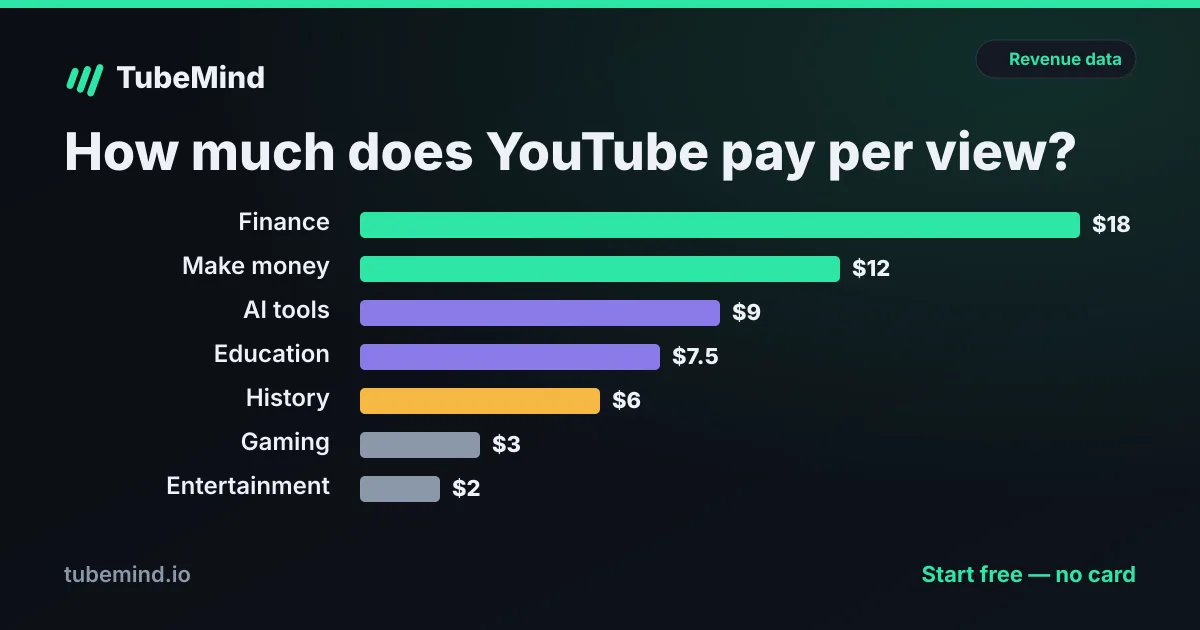
Estimated US RPM ranges by niche (what the creator keeps per 1,000 long-form views), Oct 2026, compiled from published creator-earnings reports and large aggregate studies. Estimates — YouTube does not publish per-channel rates. See how RPM really works.
The myth to delete first: "$3,000–$5,000 per million"
You’ve seen that figure everywhere, and here’s the uncomfortable truth: it’s usually wrong. Most articles quote the advertiser CPM — what brands pay — and present it as what you take home. Those are not the same number. After YouTube’s cut and the un-monetized views, a "$5 CPM" often becomes a ~$2.30 RPM.
So the honest number for a million long-form views, for a typical channel, is closer to $2,000–$3,000 — not $5,000. The high end is real, but it belongs to specific niches, not everyone. We’d rather tell you that now than have you plan your life around a number that doesn’t show up in your bank account.
Why the niche decides almost everything
Here’s the part that makes it all click. YouTube doesn’t pay you for views — it pays you a slice of what advertisers pay to run ads on your video. And advertisers bid wildly different amounts depending on who’s watching.
Picture it from the advertiser’s side. A bank will pay a small fortune to reach someone watching "best credit cards for 2026" — that viewer might open an account worth thousands. A snack brand on a gaming montage? Pennies, because that view is worth far less to them. You never see this auction happening, but it’s the entire reason a finance video can out-earn a gaming video eight to ten times over on identical views.
And here’s the twist nobody tells beginners: finance isn’t always king
"Finance pays the most" is the internet’s favourite advice — and the data complicates it. In large aggregate studies, education, "how-to" and business content often match or beat finance by median RPM. Why? Finance has a handful of mega-earners that pull the average sky-high, but the typical finance channel earns less than you’d think — while a solid education or tutorial channel quietly earns more, more consistently. So don’t force yourself into finance if you’d be better at teaching something. The money follows advertiser demand, and plenty of "boring" niches have it.
What this means for real view counts
Ranges are hard to feel, so let’s make them concrete. Here’s the full earnings ladder for a monetized long-form channel — a realistic median column, plus the high-RPM-niche column so you can see the spread:
| Views | Typical (median, ~$2.30 RPM) | High-RPM niche (~$15 RPM) |
|---|---|---|
| 1,000 | $2 – $3 | $14 – $22 |
| 10,000 | $20 – $35 | $140 – $220 |
| 100,000 | $200 – $350 | $1,400 – $2,200 |
| 500,000 | $1,000 – $1,800 | $7,000 – $11,000 |
| 1,000,000 | $2,000 – $3,500 | $14,000 – $22,000 |
| 10,000,000 | $20,000 – $35,000 | $140,000 – $220,000 |
Long-form, monetized, US-leaning audience. Ad revenue only — sponsorships, memberships and affiliates are on top. Estimates, not YouTube figures. Run your exact niche and country in the pay-per-view tool.
The second lever: where your viewers live (this one’s for my global creators)
Almost every "how much does YouTube pay" article is written as if everyone’s audience is American. If you’re creating from Pakistan, India, Nigeria or the Philippines, you already know that’s not your reality — so let’s talk real numbers.
The same video, same niche, pays very differently depending on where your viewers sit, because advertisers pay more to reach some countries. Here’s the gap that reshapes everything:
| Audience country | Rough CPM (what advertisers pay) | vs US |
|---|---|---|
| United States | $14 – $15 | 1.0× |
| Australia / UK | $9 – $14 | ~0.8–0.9× |
| UAE / Gulf | $4 – $7 | ~0.4× |
| Pakistan | $0.40 – $1.70 | ~0.05–0.12× |
| India | $0.70 – $1.40 | ~0.05–0.10× |
Approximate advertiser CPM by audience country (your RPM is lower); the gap between the top and bottom country can reach ~30×. Estimates compiled from public CPM studies, 2025–26.
That looks brutal — but here’s the quietly hopeful part, and it’s the most important sentence in this article: you don’t have to live in a high-paying country to earn its rates. You just have to make content people there want to watch. Create in English, pick a high-RPM niche, and pull in even a slice of US/UK audience, and your effective pay per view multiplies. A Pakistani creator making English finance or tech content for a global audience can out-earn a much bigger local-language entertainment channel. See your own country-and-niche number in the pay-per-view tool.
What about Shorts? (brace yourself)
If you came hoping Shorts are the fast lane to money — gently, they’re not, at least not from ads. Shorts pay from a shared pool, and the rate is tiny: about $0.01 to $0.07 per 1,000 views. That’s not a typo. A million Shorts views might earn $30–$100, while a million long-form views earns thousands. Put differently: it takes roughly 7,000–33,000 Shorts views to equal the ad money of 1,000 long-form views.
One extra catch: adding licensed music to a Short shares your slice with the rights-holders, shrinking it further. None of this makes Shorts useless — they’re one of the best free ways to get discovered and funnel new subscribers to your long-form videos, where the real money lives. Think of Shorts as the front door, not the cash register.
First, you have to be allowed to earn
A quick reality check before you do the math on your views: you can’t earn a cent from ads until you’re accepted into the YouTube Partner Program. The key: 1,000 subscribers and 4,000 public watch hours in the last 12 months (or 10 million Shorts views in 90 days). Hit that, monetization switches on, and you earn from the very next view. Your earnings then pay out monthly through AdSense once you cross the $100 balance — with about a month’s delay before the first one lands.
Not there yet? That’s normal, and the right first goal. And one encouraging fact: a video keeps earning forever. An evergreen video that gets rediscovered two years later pays you again on every new view — which is why searchable, lasting topics beat chasing trends. Here’s how to find a niche that can actually get you monetized.
One change on the horizon: February 2027
Worth a heads-up so you’re not blindsided: from February 2027, YouTube is tightening how it monetizes — a higher qualified-view bar for Shorts and adjustments to how the Shorts and Premium revenue pools are split. It’s aimed mainly at low-effort and reused content, so if you’re making original videos you should see little change. But it’s a reminder that the rules move, and original work is always the safe side of them.
A straight note on these numbers
We’d rather be honest than hype you up. Every figure here is an estimate — YouTube never publishes what it pays any individual channel, and anyone who gives you one exact number is guessing. Real earnings swing with the season (December pays far more than January), your video length, how many viewers skip ads, and your precise audience. And remember: ads are often only half the story — for many creators, sponsorships, memberships and affiliates earn more than YouTube ads ever do. Want the full method behind these figures? Read how RPM really works.
The bottom line
So — how much does YouTube pay per view? For most channels, a fraction of a cent on long-form; a little more in rich niches; almost nothing on Shorts. But that’s the boring half of the answer. The useful half is this: your pay per view is mostly decided before you ever hit record — by the niche you pick and the audience you build. Choose a topic advertisers value, reach viewers in countries they pay for, and the same effort quietly earns you several times more. That one decision outweighs any upload schedule. Check your own number, start with a real niche verdict, and make your views count.
Sources & method
Per-view, RPM and country-CPM figures are compiled from published creator-earnings reports, large aggregate MCN studies and niche CPM/RPM data (2025–26), cross-checked against the TubeMind index. Partner Program thresholds and the 2027 changes are from YouTube’s official monetization policies. All earnings are estimates; YouTube does not publish per-channel pay. Figures exclude sponsorships, memberships and affiliate income.
Frequently asked questions
How much does YouTube pay per 1,000 views?
The honest, data-backed middle is about $2–$5 per 1,000 views (the measured median across large samples is roughly $2.30). High-value niches like finance, business and education push to $10–$30+, while gaming and entertainment sit near $1–$3. So the real range is $1 to $30 — your niche and audience country decide where you land. Shorts pay far less: about $0.01–$0.07 per 1,000 views.
How much does YouTube pay for 1 million views?
For a typical channel, around $2,000–$5,000 from ads on a million long-form views (the measured median is ~$2,300). Beware the "$3,000–$5,000 guaranteed" claims — many guides quote the advertiser CPM, not what you actually keep. High-RPM niches (finance, education, business) can reach $10,000–$40,000; gaming and entertainment often see $1,000–$3,000. A million Shorts views pays only about $30–$100.
How much does YouTube pay per view?
Roughly $0.002–$0.005 per view on average, up to $0.01–$0.02 in high-paying niches, and only a tiny fraction of a cent on Shorts. "Per view" is really shorthand for RPM ÷ 1,000 — YouTube pays per ad shown, not per view, and not every view shows an ad.
How much does YouTube pay in Pakistan, India and other countries?
Much less than the US — often 0.05×–0.25× US rates, because advertisers pay less to reach those audiences. US CPM runs ~$14–15; India sits near $0.70–$1.40 and Pakistan around $0.40–$1.70. The gap between the top and bottom country can be 30×. The fix: make English content in a high-RPM niche and build some US/UK audience — you can earn near-US rates from anywhere.
Does YouTube pay for Shorts, and how much?
Yes, from a shared Shorts ad pool — but it’s small: about $0.01–$0.07 per 1,000 views, roughly 3–14% of long-form RPM. Rule of thumb: it takes 7,000–33,000 Shorts views to equal the ad money from 1,000 long-form views. Treat Shorts as free discovery that feeds your long-form, not as the payday.
Which niche actually pays the most? (It may surprise you.)
Everyone says finance — but large aggregate studies tell a more interesting story: by median RPM, education, "how-to" and business content often matches or beats finance, because finance has a few huge earners dragging the average up while its median sits lower. The safe takeaway: money, business, tech and education niches pay several times what gaming, vlogs and entertainment do.
Does YouTube pay per view or per ad?
Per ad, technically. You earn when a viewer sees or interacts with an ad, and not every view shows one. "Pay per view" is just the simple way to describe total ad earnings ÷ total views — your RPM.
What’s the difference between CPM and RPM?
CPM is what advertisers pay per 1,000 ad impressions. RPM is what you keep per 1,000 video views, after YouTube’s 45% cut and after views that showed no ad. RPM is always lower than CPM — usually about half — and it’s the number that predicts your income.
How many views do you need to make money on YouTube?
To earn anything from ads you must first join the YouTube Partner Program: 1,000 subscribers plus 4,000 public watch hours in a year (or 10M Shorts views in 90 days). After that there’s no minimum — you earn from view one. To reach ~$2,000/month from ads at a typical RPM, you’d need roughly 400,000–900,000 views a month, or far fewer in a high-RPM niche.
Do YouTubers get paid monthly? When does the money arrive?
Yes — AdSense pays monthly, but only once your balance crosses the $100 threshold. Earnings for a month are finalized in the next month and paid around the 21st, so there’s a built-in delay before your first real payout lands.
Do you get paid again when an old video gets new views?
Yes. Ad revenue is tied to views, not upload date — a two-year-old video that suddenly gets picked up keeps earning on every new monetized view. This is exactly why evergreen, searchable topics beat chasing trends: they pay you for years.
Does using music in a Short reduce its earnings?
It can. When you add licensed music to a Short, the music rights-holders take a share of that Short’s portion of the revenue pool, lowering what reaches you. Original or royalty-free audio keeps the full share.
Can you make a living from YouTube ad revenue alone?
Some do, but most full-time creators don’t rely on ads alone. For many, sponsorships, memberships, affiliates and their own products earn more than YouTube ads. Think of ad revenue as the floor, not the ceiling.
Are YouTube’s monetization rules changing in 2027?
Yes — from February 2027, YouTube is tightening Partner Program and Shorts monetization (including a higher qualified-view bar for Shorts and changes to how the Premium/Shorts pools are split). It mostly affects low-effort and reused content; original creators should see little change, but it’s worth watching.
Put this into practice
Research any channel or niche free — no card, no channel connection.
Start free →