In this guide
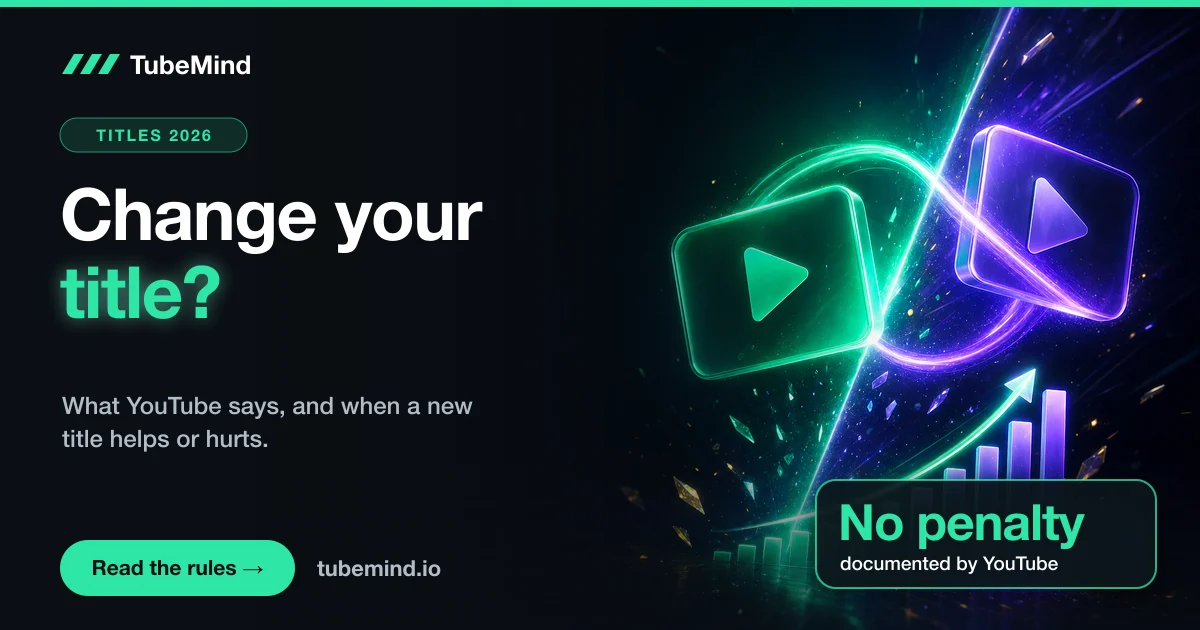
Short answer: No. YouTube documents no penalty or "reset" for changing a title after upload. A new title changes which searches your video matches and how viewers react to it, and that reaction decides what happens next. For a fair test, use YouTube's own Test and Compare, which tests up to 3 titles and picks a winner by watch time share.
Key takeaways
- YouTube Help has no page saying a title edit hurts or resets a video. The only official editing rule is that changing a title during a test stops the test.
- Test and Compare can test titles, thumbnails, or both, with up to 3 versions. Tests should finish within two weeks, and the winner is chosen by watch time share.
- Title testing went global on 4 December 2025 for long videos on desktop YouTube Studio. Shorts cannot be A/B tested.
- Titles are an official search relevance signal, so a title change can move a search driven video up or down for its keywords.
- Changing an old title into a misleading one carries policy risk. YouTube removes egregious clickbait, starting with new uploads (December 2024).
"Will I kill my video if I change the title?" I see this question every week in creator groups, usually from someone whose video stalled at a few hundred views. The fear is that YouTube will treat the edit as a red flag, or that the video will lose whatever momentum it had.
I have been on YouTube since 2018, and I build TubeMind, which tracks title changes on public videos. On 7 November 2026 I went through what YouTube itself has published on this: the Test and Compare help page, the search help page, the spam policy, and what YouTube staff have said on the record. Here is what holds up, and a simple table to decide whether you should change a title at all.
What YouTube says about changing titles
YouTube has not published any rule that punishes a title change. Its help pages describe how to change titles, and how to test them, but none says an edit lowers reach or restarts a video.
What YouTube staff have said points the same way. YouTube's Creator Liaison, Rene Ritchie, described changing a title and thumbnail to reach a broader audience as a normal tactic: "I change the thumbnail, change the title, and now I'm targeting the broader audience" (Search Engine Journal, August 2023). In a June 2024 interview published by vidIQ, a member of YouTube's discovery team said a change is picked up within seconds and that results come from audience reactions, with no algorithm boost.
The idea behind both statements is the one YouTube repeats often: the system follows the audience. A new title is a new offer to viewers. If more of the right people click and keep watching, the video gets shown more. If fewer do, it gets shown less. The edit itself is neutral.
Search vs browse: where a title change matters most
A title change can move your search rankings, because YouTube uses the title to judge what a video is about. It matters less in browse features, where viewer response does most of the work.
YouTube's help page on how search works says relevance looks at "how well the title, tags, description, and video content match your search query". So if most of your views come from YouTube search, the title is part of how you rank. Change "My trip to Hunza" to "Hunza travel guide: 5 day itinerary and costs" and you start matching different searches. That can lift the video, or drop it for the searches it already ranked for.
On Home and Up next, YouTube shows videos to people it thinks will enjoy them, based on how viewers respond. There a new title works like a new thumbnail: it changes who clicks.
Before you edit, open the video in YouTube Studio, go to Analytics, then Reach, and look at traffic sources. That one screen tells you which of the two cases you are in.
Test and Compare: the official way to try a new title
Test and Compare is YouTube's built in A/B test. It shows different versions to different viewers at the same time and picks a winner by watch time, which is fairer than changing a title by hand and comparing two different weeks.
| Question | Answer from YouTube Help |
|---|---|
| What can you test? | Title only, thumbnail only, or title and thumbnail together |
| How many versions? | Up to 3 |
| How long does a test run? | It should finish within two weeks, sometimes in a few days |
| How is the winner picked? | Watch time share |
| Possible results | Winner, Performed same, or Inconclusive (your original stays) |
| Where can you run it? | YouTube Studio on a computer, with advanced features turned on |
| What cannot be tested? | Shorts, made for kids videos, age restricted videos, private videos and scheduled lives |
| Can you edit during a test? | No. Changing the title or thumbnail stops the test |
Thumbnail testing came first, after YouTube announced it in 2023. Title testing started as a small experiment in July 2025 and rolled out to all creators with advanced features on 4 December 2025, according to Search Engine Journal. YouTube said it optimizes for overall watch time rather than click through rate, which matters: a title that gets clicks but disappoints viewers will not win.
How to start one: in YouTube Studio on a computer, open the video's details page, find Test and Compare next to the thumbnail, choose title, thumbnail or both, and add your versions. Then leave the video alone until the result comes in.
Should you change this title? A decision table
The right move depends on how old the video is and where its views come from. This is my rule of thumb, built on the facts above.
| Your video | Main traffic | What I would do | Risk |
|---|---|---|---|
| Uploaded in the last 2 to 3 days | Any | Wait. Early numbers swing a lot on new videos | Reacting to noise |
| A week old, very low impressions | Search | Rewrite the title around what people search, or test it | Low, little to lose |
| A week old, impressions but few clicks | Browse | Run Test and Compare on title and thumbnail | Low |
| Steady evergreen views from search | Search | Leave it, or test carefully | High: you can lose rankings you already have |
| Old video that has faded | Browse or suggested | Test a fresh angle and thumbnail | Low |
| A Short | Shorts feed | Titles matter little in the feed and cannot be A/B tested. Make a new Short instead | Low |
The one case where I would be careful is the steady search video. If a video brings you views every day from a keyword, a new title can move it off that keyword. Test it, or keep the main keyword in the new title.
How to tell if a manual title change worked
If you cannot use Test and Compare, for example on a Short, change one thing at a time and compare fair windows. This is a method, not a YouTube rule.
- Write down the old title, the date, and the last 7 days of views, impressions and impressions click through rate.
- Change only the title. Leave the thumbnail alone for now.
- Wait at least 7 days, then compare the same 7 day stretch, so weekdays match weekdays.
- Look at impressions click through rate and average view duration together. More clicks with much shorter watching is not a win.
- Remember outside causes. A trend, a mention or a seasonal spike can move views on their own.
TubeMind tracks this for public videos too. Our Title Change Winners feature records when an indexed video's title changes, then compares views per day after the change with views per day in the 14 days before it. It only judges long videos at least 14 days old, with 10 or more views a day before the change and at least 7 days of data after it. As of 7 November 2026 it had 760 changes still collecting data, so I will add real results here once enough have finished.
Do not turn a better title into clickbait
Changing a title is safe. Changing it into a promise the video does not keep is not. YouTube's spam policy bans "maliciously misleading titles, thumbnails, descriptions, or imagery", for example a title that promises a full match when the video shows a clip.
In December 2024, YouTube announced stronger action against egregious clickbait: titles or thumbnails with promises "that aren't delivered within the video itself", especially for news and current events. It said it would start by removing such videos without a strike and focus on new uploads, beginning in India. A dramatic new title on an old news video is exactly the kind of edit to avoid.
A good test: could a viewer who clicked your new title say the video delivered what it promised? If yes, you are fine. My guide on how to write YouTube titles covers how to make a title stronger without overpromising, and the free title analyzer scores a title before you publish it.
A quick checklist for old videos
- Check traffic sources first: search driven videos need the keyword kept in the title.
- Prefer Test and Compare for long videos. It removes the guesswork.
- Change one thing at a time when you edit by hand.
- Give every change at least 7 days before judging it.
- Keep the promise honest to the content.
- Pair the new title with a thumbnail that tells the same story. See thumbnail size and design.
If a video gets no impressions at all, a new title will not fix it on its own. Start with why a new channel gets no impressions.
What this guide cannot tell you
- YouTube has not published how quickly a title change takes effect. The "within seconds" comment comes from one interview, not a help page.
- Most claims online, like "wait 48 to 72 hours before changing", are creator advice, not YouTube rules.
- Results from one channel do not transfer to another. Your audience decides.
Sources
YouTube Help: Test and Compare thumbnails and titles, how YouTube search works and spam, deceptive practices and scams policy. Google India blog: strengthening enforcement against egregious clickbait, 18 December 2024. Search Engine Journal: title A/B testing rolls out globally and insights from Creator Liaison Rene Ritchie. Tubefilter on the July 2025 title test experiment. All read on 7 November 2026. TubeMind's title change method is described above and in how our scores work. The Hunza title is a made up example.
Want a second opinion on a new title? Score it free with the title analyzer.
Research right on YouTube: the free TubeMind Chrome extension shows the outlier multiplier, a revenue estimate and similar channels on YouTube pages.
Frequently asked questions
Does changing a YouTube title reset the algorithm?
YouTube has published no rule that a title change resets or penalizes a video. The new title changes which searches the video matches and how viewers respond, and that response decides what happens next.
Can you A/B test titles on YouTube?
Yes. Test and Compare in YouTube Studio on a computer can test up to 3 titles, thumbnails, or both. Title testing rolled out to all creators with advanced features on 4 December 2025. Shorts cannot be tested.
How does Test and Compare pick a winner?
By watch time share, according to YouTube Help. A test should finish within two weeks and ends as Winner, Performed same, or Inconclusive, in which case your original title stays.
How long should I wait after changing a title?
YouTube has not published a waiting time. Compare at least 7 days after the change with the 7 days before it, so weekdays match, and change one thing at a time.
Can changing a title get my video removed?
Only if the new title misleads viewers. YouTube's spam policy bans maliciously misleading titles, and since December 2024 YouTube removes egregious clickbait, starting with new uploads.