How many views do you need to get paid on YouTube? (By niche and country)
You’re not paid per view — you’re paid by engaged views × RPM. See how many views it takes to earn $100, $1,000 or a full-time income by niche and country, plus the YPP rules (and the 2027 change).

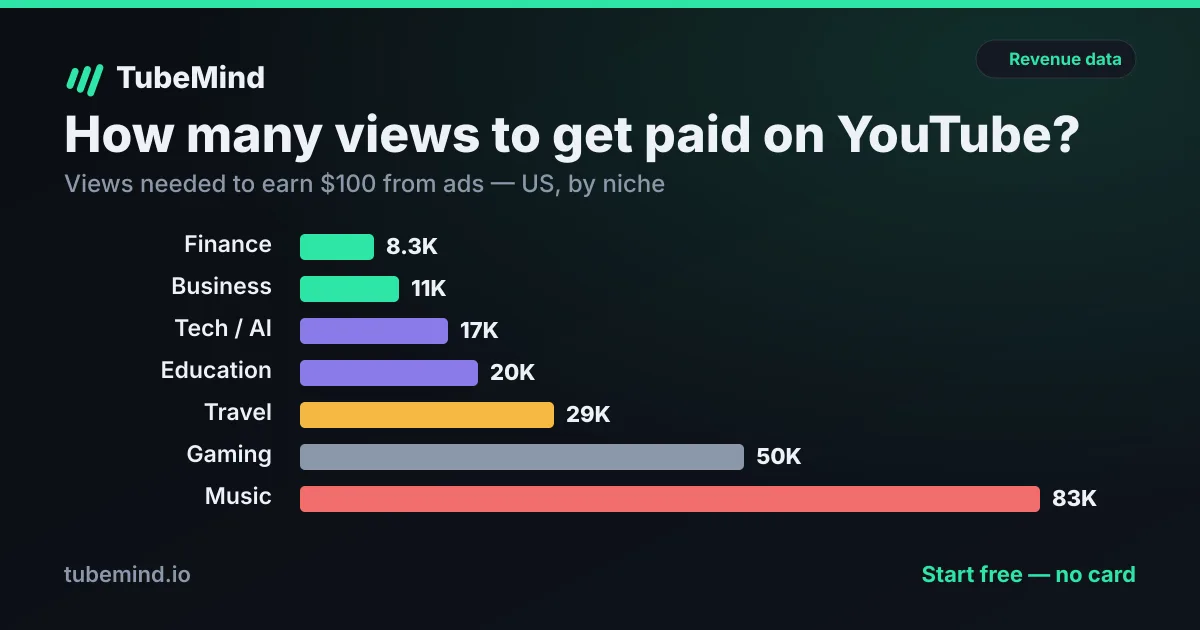
“How many views do I need before YouTube starts paying me?”
It’s one of the first questions every new creator asks — and almost every answer online gets it half-wrong. People throw out a number like “you need a million views” as if there’s a single finish line. There isn’t. There are really two questions hiding inside that one: when am I allowed to earn, and how much does each view actually pay. Get both straight and you’ll plan your channel completely differently. Let’s take them in order.
First, the one real gate: the Partner Program
Before any money moves, YouTube has to let you in. That’s the YouTube Partner Program (YPP), and for ad revenue there are two doors:
| Route | What you need (today) |
|---|---|
| Long-form | 1,000 subscribers + 4,000 qualified watch hours in the last 12 months |
| Shorts | 1,000 subscribers + 10 million qualified Shorts views in the last 90 days |
You qualify through one path or the other — and a common myth is that Shorts-feed watch time counts toward the 4,000 long-form hours. It doesn’t. They’re separate ladders. Hit either one, get approved, and you’re eligible to earn. Notice what’s not on this list: a view count for payment. Once you’re in, there’s no “minimum views to get paid” — the gate is about joining.
There’s also a lower door worth knowing: a 500-subscriber tier (available in many countries) that unlocks fan funding — channel memberships, Super Thanks and Shopping — with 500 subscribers, 3 public uploads in 90 days, and 3,000 watch hours (or 3M Shorts views). It does not turn on ads — that still needs the 1,000-sub program — but it lets a small channel start earning from its real fans earlier.
These thresholds are YouTube’s own program rules, not TubeMind estimates, and YouTube can change them — always check the official requirements before you count on a number.
You’re not paid per view — you’re paid by engaged views × RPM
Here’s the idea that changes everything. Two creators can both get 100,000 views this month and earn wildly different amounts. Why? Because YouTube doesn’t hand out a flat rate per view. What you actually keep per 1,000 views is a number called RPM — your true take-home pay rate — and it swings hugely with what you talk about.
One honest nuance most pages skip: the number that drives earnings is engaged views, not the big public view counter. Since YouTube changed how views are counted (Aug 2026), a view registers the instant playback starts — so your public count can run ahead of the engaged count that actually feeds RPM. You can see engaged views in YouTube Studio under Analytics → Advanced mode. So the real formula is:
Earnings ≈ engaged views ÷ 1,000 × RPM
The real question, then, isn’t “how many views do I need?” It’s “how many views do I need in my niche?” Let’s put numbers on it.
How many views to earn $100, $1,000 and a full-time income
Below is what it takes to hit each income milestone from ad revenue alone, by niche, for a US long-form audience. These are TubeMind estimates shown as typical ranges — honest ballparks, not secret YouTube figures. Real RPM varies a lot channel to channel, so treat the “typical” column as a middle-of-the-road case, not a promise.
| Niche | Typical RPM (range) | Views for $100 | Views for $1,000 | Views for $5,000/mo |
|---|---|---|---|---|
| Finance / investing | $12 ($6–$21) | ~8,300 | ~83,000 | ~417,000 |
| Business / SaaS / crypto | $9 ($5–$15) | ~11,100 | ~111,000 | ~556,000 |
| Make money / marketing | $8 ($4–$13) | ~12,500 | ~125,000 | ~625,000 |
| Tech / AI / health | $6 ($3–$10) | ~16,700 | ~167,000 | ~833,000 |
| Education / how-to | $5 ($3–$10) | ~20,000 | ~200,000 | ~1,000,000 |
| Travel / history | $3.50 ($2–$6) | ~28,600 | ~286,000 | ~1,430,000 |
| Vlog / lifestyle | $3 ($1.50–$5) | ~33,300 | ~333,000 | ~1,670,000 |
| Gaming | $2 ($1–$4) | ~50,000 | ~500,000 | ~2,500,000 |
| Entertainment / comedy | $1.80 ($1–$3) | ~55,600 | ~556,000 | ~2,780,000 |
| Music / kids | $1.20 ($0.50–$2) | ~83,300 | ~833,000 | ~4,170,000 |
Look at the top and bottom. For the exact same $5,000 month, a finance channel needs about 417,000 views and a music channel needs 4.2 million — a 10× gap decided before either creator films a frame. That’s not talent or luck. It’s the niche.
Reality check on the ranges: a measured 300-channel study (AIR Media-Tech, 2025–26) found an all-niche median RPM near $2.30, with education around $10 and kids near $0.33 — so if your real RPM sits at the low end of these ranges, that’s normal, not a mistake. The high end ($18–21 finance) is a top-performing US channel, not the average.
Want to run your own niche and view count? The free YouTube money calculator does this instantly — pick your niche and country, type your views, and it shows ad revenue plus a sponsorship and membership estimate on top.
The second lever: where your viewers live
Here’s what nearly every “views to get paid” article forgets. Advertisers pay very different amounts to reach different countries — so the same video, in the same niche, pays differently depending on who’s watching.
A US viewer is worth roughly 4–5× a viewer in India or Pakistan. So the view counts above aren’t universal — they assume a US audience. Here’s how many views it takes to earn $100 in a mid-RPM niche (education, ~$5 US base), by audience country:
| Audience country | Est. RPM | Views for $100 |
|---|---|---|
| United States | $5.00 | ~20,000 |
| United Kingdom | $4.25 | ~23,500 |
| Canada / Australia | $4.50 | ~22,200 |
| Germany | $3.75 | ~26,700 |
| UAE / Saudi Arabia | $3.00–$3.50 | ~28,600–33,300 |
| Brazil / Mexico | $2.00 | ~50,000 |
| India | $1.25 | ~80,000 |
| Pakistan | $1.00 | ~100,000 |
Same effort, same niche — but a US audience reaches $100 in about 20,000 views, while a Pakistani audience needs around 100,000. If you’re in South Asia, sit with that: see the full breakdown in YouTube RPM in Pakistan, or compare every country with the RPM-by-country tool.
Why doesn’t every view pay?
If you’ve ever watched your view count climb while your revenue crawled, this is why. A view only earns ad money when an ad is actually served on it — and that’s not every view.
- YouTube keeps ~45% of long-form ad revenue. You keep 55%. (On Shorts it’s different — more below.)
- Only about half of views are monetized. Ad blockers, YouTube Premium viewers (who pay through a separate pool), limited-ads or non-advertiser-friendly content, and viewers who leave before an ad all mean a chunk of your views show no ad.
- This gap is exactly why RPM is lower than CPM. CPM is what advertisers pay per 1,000 ad impressions; RPM is what you keep per 1,000 video views after the cut and the unmonetized views. RPM is the number that predicts your income — see RPM explained.
From watch hours to views: what 4,000 (soon 8,000) hours really looks like
People obsess over the hours without realizing how many views they imply — and it depends entirely on how long your average view lasts. Here’s the rough conversion:
| Avg view duration | Views for 4,000 hours | Views for 8,000 hours (2027) |
|---|---|---|
| 2 minutes | ~120,000 | ~240,000 |
| 4 minutes | ~60,000 | ~120,000 |
| 8 minutes | ~30,000 | ~60,000 |
| 12 minutes | ~20,000 | ~40,000 |
The lesson: longer, genuinely watchable videos get you monetized on far fewer views. A channel with 12-minute videos needs a third of the views of a 4-minute channel to clear the same watch-hour bar.
What about Shorts?
Shorts play by different rules. Instead of watch-page ads, Shorts earnings come from a Creator Pool — ad money from the Shorts feed, pooled and shared out by each creator’s share of engaged views (after music licensing), and you keep 45% of your allocation. In practice Shorts RPM is a small fraction of long-form — often just a few cents per 1,000 views — so it typically takes 1–2.5 million Shorts views to earn $100. Shorts are a growth and reach engine first, an ad-income engine a distant second. (And from Feb 2027, earning from the Shorts pool each month requires maintaining 10M qualified Shorts views over the trailing 90 days.)
“But how many subscribers do I need?” — the honest answer
Let’s kill the biggest myth cleanly: YouTube does not pay you for subscribers. Not a cent. Subscribers do exactly two money-related things — they unlock the 500-sub fan-funding tier and the 1,000-sub ad program. After that, your income is driven by views and RPM, full stop.
That’s why a tiny channel can out-earn a big one. A 1,000-subscriber finance channel pulling 200,000 views a month beats a 100,000-subscriber vlog channel that posts twice a year. Subscribers are a gate; views are the paycheck. Anyone quoting “YouTube pays $X per subscriber” doesn’t understand how this works.
How you actually get the money (the part most guides skip)
“Earning” and “getting paid” aren’t the same moment. Two things have to happen:
- Your AdSense balance must reach $100. That’s YouTube’s payout threshold. Under $100 in a month, the balance simply rolls over until it crosses the line.
- A payment cycle completes. YouTube finalizes a month’s earnings around the 7th–12th of the next month and pays out around the 21st–26th, assuming you’re over $100 and have no holds.
So for a small channel, the first real payment can land several months after you’re accepted — you’re accumulating toward $100 first. You’ll also need to set up AdSense and submit US tax info (a W-9 for US creators, W-8BEN for others); skip the tax form and Google may withhold up to 24% of your worldwide earnings, so do it on day one.
What this means for your channel
Put it together and the planning order flips. Most new creators pick a topic they like, grind for views, and then wonder why the money is thin. The creators who earn well do it backwards:
- Decide the income you want. $500 a month? Full-time? Put a real number on it — and if “full-time” is the goal, remember a $5,000 gross month shrinks after self-employment tax and costs.
- Pick a niche whose RPM makes that reachable. A $500 month needs ~42,000 monthly views in finance — or ~250,000 in gaming. Same goal, very different mountain.
- Know your audience country. A Western audience can make a small channel profitable; a low-RPM audience means you need volume.
- Then chase views — and don’t rely on ads alone. Almost no full-time creator lives on ad revenue; they stack sponsorships, memberships and their own products on top. Ads are the floor, not the ceiling.
None of this means you can’t win in a low-RPM niche — gaming and entertainment creators earn fortunes through sheer scale and sponsorships. It just means you should walk in knowing the math, not discovering it a year later.
The fastest way to see your own picture: open the money calculator, enter your niche, country and a realistic monthly view count, and watch the number move. It’s the honest answer to “how many views do I need” — tailored to you, in about ten seconds.
A note on the numbers: every RPM figure here is a TubeMind estimate from our 95-niche, 27-country model and public creator-earnings reports — labelled as estimates, because real RPM swings with season, format, watch time, audience and ad mix. Program thresholds and payment details are from YouTube’s own Help Center and were current as of this article’s date; YouTube can change them, so verify before you rely on a number. TubeMind isn’t affiliated with YouTube. For the mechanics behind RPM, read how YouTube revenue and RPM actually work.
Frequently asked questions
How many views do you need to get paid on YouTube?
Two separate things decide this. First you must be eligible by joining the YouTube Partner Program — today that needs 1,000 subscribers plus 4,000 qualified watch hours in 12 months, or 1,000 subscribers plus 10M Shorts views in 90 days. (From 1 Feb 2027 the bar for new applicants rises to 8,000 watch hours or 20M Shorts views.) After you’re accepted there’s no minimum view count — every monetized view earns. How much depends on your niche and audience country: a US finance channel might reach $100 in roughly 8,000 views, while a gaming channel needs around 40,000 for the same $100.
How many subscribers do you need to get paid on YouTube?
You need 1,000 subscribers to apply to the Partner Program for ad revenue — but subscribers are an eligibility gate, not a pay source. YouTube pays you for views (and the ads on them), not for subscribers. There is also a lower 500-subscriber tier (in many countries) that unlocks fan funding — memberships, Super Thanks and Shopping — but not ad revenue. A 1,000-subscriber channel pulling 200,000 monthly views earns far more than a 100,000-subscriber channel that rarely posts.
How many views is $100 on YouTube?
It depends on your niche and audience. As a US long-form estimate using mid-range RPMs: finance (~$12) hits $100 near 8,300 views; tech (~$6) near 16,700; education (~$5) near 20,000; gaming (~$2) near 50,000. Note $100 is also YouTube’s payout threshold — your AdSense balance must reach $100 before any money is sent. For a lower-RPM country like India or Pakistan, multiply those view counts by 4–5×. Try your own numbers in the money calculator.
How many views do you need to make a living on YouTube?
Work backwards from a real target. Say “a living” is $5,000/month gross (before self-employment tax and costs). On ads alone a US finance channel (~$12 RPM) needs about 417,000 views a month; a US gaming channel (~$2 RPM) needs about 2.5 million. That’s a 6× gap for the same paycheck — which is why niche and country matter more than raw views. In reality almost no full-time creator lives on ads alone; they stack sponsorships, memberships and their own products on top.
Does YouTube pay you for views before you were monetized?
No. Ad revenue only starts once you’re accepted into the Partner Program, and YouTube does not back-pay views that happened before acceptance. Those earlier views still count toward your watch-hour total to get you in — they just don’t pay. After acceptance, your old videos keep earning on any new views they get.
Are the YouTube monetization requirements changing in 2027?
Yes. From 1 February 2027, new applicants to the Partner Program will need 8,000 qualified watch hours (up from 4,000) in 365 days, or 20 million qualified Shorts views (up from 10M) in 90 days — still alongside 1,000 subscribers. Creators already in YPP are not affected, but must accept updated terms by 31 Jan 2027. If you’re near 4,000 hours now, apply before the deadline — applications already in review are judged under the old rules.
Do Shorts views count toward the 4,000 watch hours?
No. Watch time from the Shorts feed does not count toward the 4,000 (soon 8,000) long-form watch hours. Shorts have their own route — 10M Shorts views in 90 days (20M from Feb 2027). You qualify through one path or the other, not by mixing them.
Why doesn’t every view earn money?
Because ad revenue needs an ad. YouTube keeps ~45% of long-form ad revenue (you keep 55%), and a view only pays when an ad is actually served — which isn’t every view. Ad blockers, YouTube Premium viewers, limited-ads or non-advertiser-friendly content, and viewers who skip before an ad all mean a share of your views earn nothing from ads. Industry data suggests only roughly half of views are monetized, which is exactly why RPM (what you keep per 1,000 views) is lower than CPM (what advertisers pay).
How long after monetization until I get my first payment?
Two gates. Your AdSense balance must reach $100, and a payment cycle has to complete: YouTube finalizes a month’s earnings around the 7th–12th of the next month and pays out around the 21st–26th, as long as you’re over the $100 threshold and have no payment holds. If you earn under $100 in a month, the balance rolls over until it crosses $100. So a small channel’s first real payment can take several months after being accepted.
Which “views” count — the public counter or engaged views?
Earnings are based on engaged views, not the public view counter. Since YouTube changed view counting (Aug 2026) a view registers the moment playback starts, so the public number can be higher than the engaged number that actually drives RPM. You can see engaged views in YouTube Studio (Analytics → Advanced mode). When you estimate with “views × RPM,” use engaged views for a realistic figure.
Can buying views or subscribers get me paid faster?
No — it does the opposite. Bought or artificial views and subscribers don’t count as qualified, won’t help you reach the thresholds, and can get your channel removed from the Partner Program or terminated. Only genuine, organic watch time counts toward monetization.
Put this into practice
Research any channel or niche free — no card, no channel connection.
Start free →