How much does YouTube pay for 1 million views? (Real creator numbers)
The same 1 million views can pay $1,600 or $29,000 — it all depends on niche, country and format. Here’s what real creators earned, with honest ranges for long-form, Shorts and every country.

Here’s a fact that breaks most people’s brains the first time they hear it.
Two creators each hit 1 million views this month. One of them earns around $1,600. The other earns close to $29,000. Same platform. Same milestone. An 18× difference in the paycheck.
That’s not a typo, and it’s not luck. It’s the single most misunderstood thing about YouTube money: a million views is not a dollar amount. It’s a dollar amount multiplied by three hidden factors — your niche, your audience’s country, and whether it’s long-form or Shorts. Get those three right and a million views can change your life. Get them wrong and you’ll wonder why your viral video bought you a nice dinner and not much else.
Let’s settle the real number — with actual creator reports, not made-up ranges.
The honest answer: $2,000 to $6,000 for most channels
For 1 million long-form views from a US audience, the realistic, defensible range is $2,000 to $6,000, with most channels clustering around $3,000–$4,000. You’ll see clickbait claiming “$10,000 per million!” or lowball posts saying “$500” — both are usually wrong, or quoting CPM (what advertisers pay) instead of RPM (what you actually keep).
The cleanest real data point comes from vidIQ, who published their own channel’s analytics: $3,231 from about 1,035,000 views. The eye-opener hidden in that number — only about 250,000 of those million views were actually monetized (showed an ad), at a $13.29 CPM. That’s the detail every lowball and highball article misses: you are never paid on all million views.
Source: vidIQ’s published channel analytics (vidiq.com). CPM is what advertisers pay per 1,000 ad impressions; RPM is what you keep per 1,000 views after YouTube’s ~45% cut and after the views that never showed an ad.
What real creators actually reported for 1 million views
Ranges are fine, but real numbers build trust. Here’s what actual creators have publicly reported — normalised to “per 1 million views” so you can compare them side by side:
| Creator / source | Niche & format | Implied pay per 1M views |
|---|---|---|
| Josh Mayo (Business Insider) | Personal finance, long-form | ~$29,300 ($29.30 RPM) |
| vidIQ channel (published analytics) | YouTube education, long-form | ~$3,231 ($13.29 CPM, ~25% monetized) |
| Unnamed entertainment channels (Business Insider) | Entertainment, long-form | ~$1,610 ($1.61 RPM) |
| vidIQ channel (published analytics) | Shorts | ~$95 ($0.09 RPM) |
| Business Insider-cited creator | Shorts (~7M views → ~$383) | ~$55 ($0.05 RPM) |
| vidIQ channel (published analytics) | Livestream | ~$10,807 ($10.69 RPM) |
Read that table twice. A finance creator’s million views (~$29,000) earned roughly 18× what an entertainment channel’s million did (~$1,610) — and 530× what a Shorts million did (~$55). The milestone is identical. The paycheck is a different universe.
Sources: Business Insider creator interviews (Josh Mayo ~$29.30 RPM; entertainment channels ~$1.61 RPM; a Shorts creator ~$0.05 per 1,000), reported via industry coverage; vidIQ figures from its own published analytics. Labelled as self-reports, not YouTube data.
1 million views by niche (the number you came for)
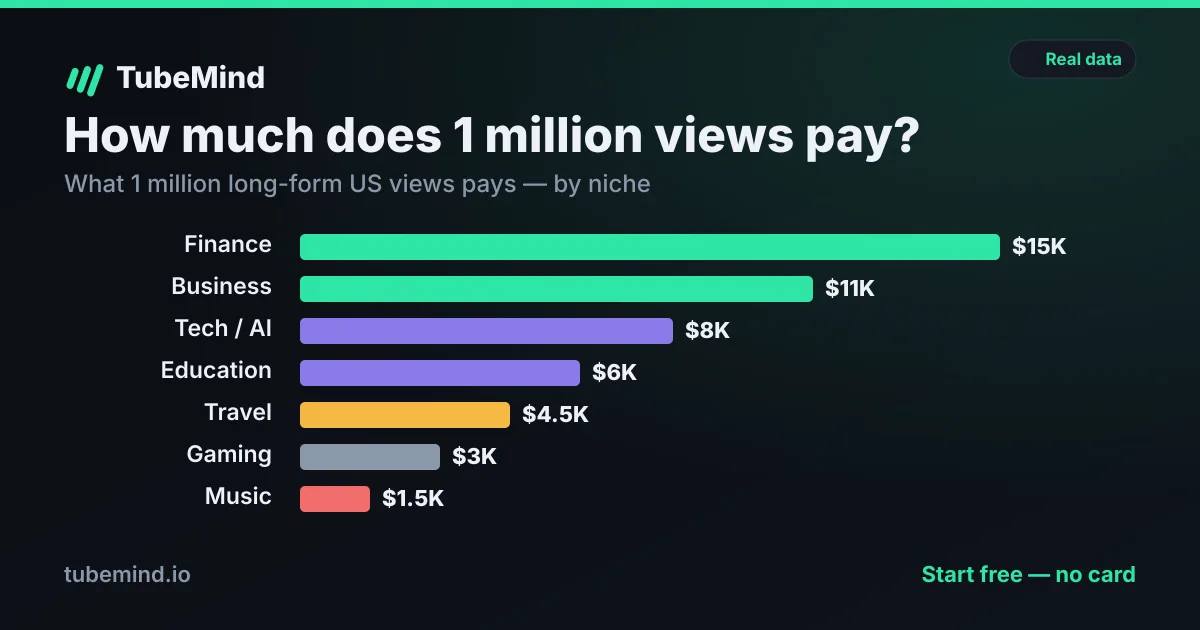
Here’s what 1 million long-form views pays by niche, for a US audience, using TubeMind’s estimated RPMs shown as typical ranges. Treat the “typical” column as a sensible middle case — real channels land anywhere in the range.
| Niche | Typical RPM | Pay for 1M views (range) |
|---|---|---|
| Finance / investing / insurance | $12–$18 | $12,000–$21,000 |
| Business / SaaS / crypto | $9–$14 | $9,000–$14,000 |
| Make money / marketing | $8–$12 | $8,000–$12,000 |
| Tech / AI / health | $6–$10 | $6,000–$10,000 |
| Education / how-to | $5–$8 | $5,000–$8,000 |
| Travel / history | $3.50–$6 | $3,500–$6,000 |
| Vlog / lifestyle | $3–$5 | $3,000–$5,000 |
| Gaming | $2–$4 | $2,000–$4,000 |
| Entertainment / comedy | $1.50–$3 | $1,500–$3,000 |
| Music / kids | $1–$2 | $1,000–$2,000 |
Want the exact figure for your niche and country? The free YouTube money calculator does it in seconds — pick your niche, set your country, type 1,000,000, and it shows the ad-revenue range plus a sponsorship and membership estimate on top.
The same million views around the world
Here’s the lever almost no article shows you. Advertisers pay by who’s watching, so the same million views — same niche, same video — pays completely differently depending on your audience’s country. In one real report, a US audience showed a CPM near $18.88 while an Indian audience on the same channel showed $1.36.
Here’s roughly what 1 million long-form views in a mid-RPM niche (education, ~$5 US base) pays by audience country:
| Audience country | Est. RPM | Pay for 1M views |
|---|---|---|
| United States | $5.00 | ~$5,000 |
| United Kingdom / Canada / Australia | $4.25–$4.50 | ~$4,250–$4,500 |
| Germany | $3.75 | ~$3,750 |
| Brazil / Mexico | $2.00 | ~$2,000 |
| India | $1.25 | ~$1,250 |
| Pakistan | $1.00 | ~$1,000 |
A US audience earns about 5× a Pakistani one for the identical million views. This is why two equally talented creators — one in California, one in Karachi — can post the same video, hit the same million, and see wildly different deposits. If you’re in South Asia, read the full picture in YouTube RPM in Pakistan.
Shorts: when 1 million views buys you lunch
If your million came from Shorts, brace yourself. Shorts don’t run watch-page ads — they share a pooled pot (the Creator Pool), and you keep 45% of your slice. The result: 1 million Shorts views typically pays $50–$300.
Real reports back this up: vidIQ earned about $95 for ~1 million Shorts views, and a Business Insider-cited creator earned roughly $383 from about 7 million Shorts views (~$0.05 per 1,000). Put bluntly: a million Shorts views can pay less than 100,000 long-form views in a decent niche. Shorts are a phenomenal growth engine — they get you discovered fast — but as an income source, they’re a rounding error next to long-form. Use them to grow the audience, then monetise with long-form. (For the full mechanics, see how many views you need to get paid.)
Why you’re never paid for all 1 million views
This is the part that quietly halves everyone’s expectations, so let’s be straight about it. Out of a million views, only a slice actually earns ad money. Remember vidIQ’s report — ~250,000 monetized out of ~1,000,000. Here’s where the rest goes:
- YouTube keeps ~45% of long-form ad revenue. You keep 55%.
- No ad, no pay. Ad blockers, YouTube Premium viewers (paid from a separate pool), limited-ads or non-advertiser-friendly content, and people who click away before an ad all mean a big chunk of views show no ad at all.
- Public views ≠ engaged views. Your public counter can run ahead of the “engaged views” that actually drive RPM.
That’s why “views × a nice CPM” always overshoots. The honest math is RPM (which already bakes in the cut and the unmonetized views) × your real engaged views — explained fully in how RPM works.
The hidden multiplier: when your million lands
One more twist most people never factor in: timing. Advertiser budgets spike in Q4 (October–December) as brands chase holiday shoppers, and crater in January when those budgets reset. A million views in December can pay noticeably more than the same million in January — vidIQ’s own CPM rose from $9.21 in January to $13.42 in October. Longer videos help too: once you pass 8 minutes you can run mid-roll ads, which lifts RPM. So the same million views can pay differently depending on the calendar and your video length.
So — is 1 million views worth chasing?
Absolutely — but go in with your eyes open. A million views is a real milestone and, in a mid-to-high RPM niche, a real paycheck. Just remember the three levers that decide what it’s worth:
- Niche sets the pay rate — finance can out-earn gaming 5–10× on identical views.
- Audience country multiplies or shrinks it — a US million is worth several Pakistani millions.
- Format decides the ballpark — long-form pays in thousands, Shorts in tens-to-hundreds.
And here’s the founder’s honest truth: the creators who actually build an income don’t chase a viral million and hope. They pick a niche whose RPM makes a million worth chasing, grow a real audience, and stack sponsorships and their own products on top of ad revenue. Ads are the floor, not the ceiling.
Curious what your own million would pay? Open the money calculator, set your niche and country, and see the honest range in ten seconds. It’s the number this whole article is really about — tailored to you.
About these numbers: the per-niche and per-country figures are TubeMind estimates from our 95-niche, 27-country model, shown as ranges because real RPM swings with season, format, watch time, audience and ad mix. The named creator figures are public self-reports (Business Insider interviews; vidIQ’s published analytics), labelled as such. The ~45% revenue split and view-counting details are from YouTube’s own Help Center. TubeMind isn’t affiliated with YouTube. Use these to plan, not to predict to the dollar.
Frequently asked questions
How much does YouTube pay for 1 million views?
For 1 million long-form US views, a realistic range is $2,000–$6,000, with most channels landing around $3,000–$4,000 — but it swings hugely by niche. A finance channel can clear $12,000+ while an entertainment channel may see under $2,000. Real example: vidIQ reported $3,231 from ~1 million views (only ~250,000 were monetized, at a $13.29 CPM). These are estimates and real-world reports, not official YouTube figures.
How much does YouTube pay for 1 million Shorts views?
Far less — Shorts run on a shared Creator Pool, not watch-page ads. 1 million Shorts views typically pays $50–$300. Reported examples: vidIQ earned ~$95 for ~1M Shorts views ($0.09 RPM), and a Business Insider-cited creator earned about $383 from ~7M Shorts views (~$0.05 per 1,000). So 1 million Shorts views can pay less than 100,000 long-form views in a good niche.
How much is 1 million views in India or Pakistan?
Much less than the US, because advertiser rates follow the audience’s country. A mostly-Indian audience often sees a CPM near $1.4–$1.9 (vs ~$19 in the US), so 1 million long-form views might pay roughly $700–$1,500 depending on niche, and a Pakistani audience a little less. A US audience can earn 4–5× more for the exact same million views. Compare countries in the RPM-by-country tool.
Why do 1 million views pay so differently for different channels?
Three levers: niche (advertisers pay 10–15× more to reach finance viewers than gaming viewers), audience country (a US view is worth several times a view from a low-CPM country), and format (long-form watch-page ads pay far more than Shorts). On top of that, only a fraction of your million views are actually monetized — in one real report just 250,000 of ~1,000,000 views showed ads.
Did MrBeast really earn millions from his videos?
Top creators like MrBeast do earn large sums, but their ad revenue per million views still follows the same RPM rules as everyone else — the difference is scale (hundreds of millions of views) and that most of their income comes from sponsorships, products and brand deals, not AdSense. Ad revenue alone, even at a high RPM, is rarely the biggest slice for mega-creators.
Is 1 million views a lot on YouTube?
For most channels, yes — it’s a genuine milestone and, in a mid-to-high RPM niche, a meaningful paycheck ($3,000–$12,000). But “a lot” depends on your niche’s pay rate: 1 million views in finance can out-earn 5 million in gaming. Views are only half the story; what those views pay is the other half.
How long does it take to get 1 million views?
There’s no fixed timeline — some videos hit 1 million in days, many channels take months or years across all their uploads combined. It depends on your niche’s demand, how often you post, and how well the algorithm pushes your content. The payout for those million views, though, is set the moment you pick your niche and audience — which is the part you can actually plan.
Put this into practice
Research any channel or niche free — no card, no channel connection.
Start free →