How much does YouTube pay for Shorts? The honest numbers
YouTube Shorts pay about $0.02–$0.15 per 1,000 views — roughly 1/30th of long-form. But there’s one niche that flips the whole thing on its head. Real data from 274 channels, explained simply.

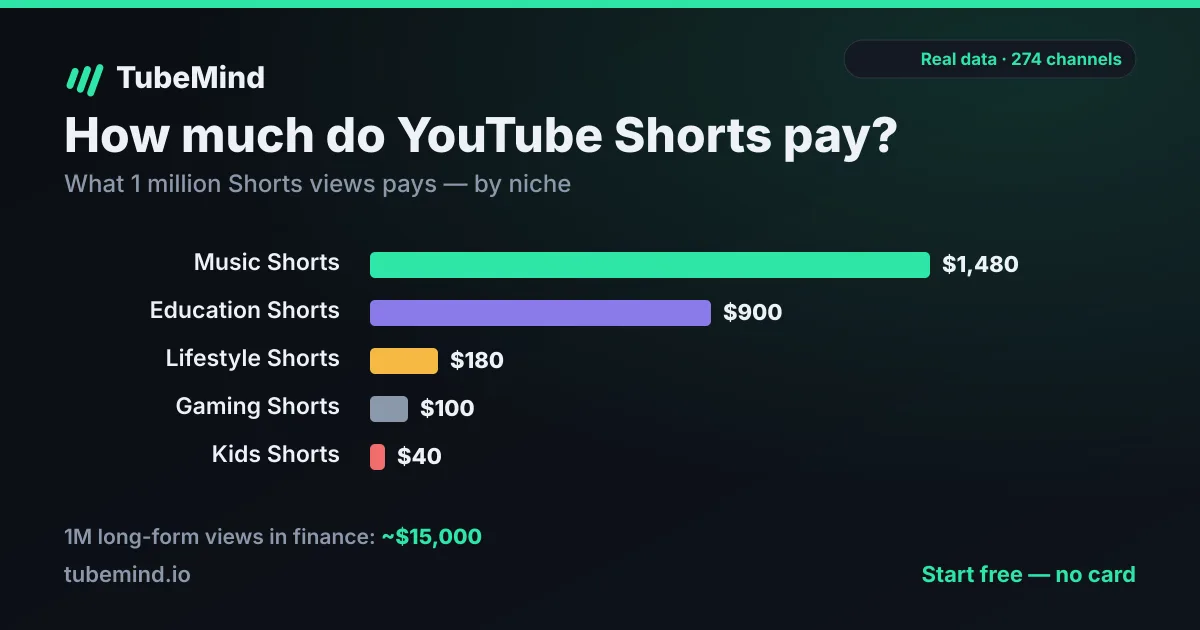
Let me guess why you’re here. You posted a Short, it blew up — half a million views, maybe a million — you felt like a star for a day… and then you checked your earnings and found a number that wouldn’t cover a pizza.
You’re not doing anything wrong. That tiny number is just how Shorts work. And once you understand why, you’ll stop feeling cheated and start using Shorts for what they’re actually brilliant at. Let’s break it down — no jargon, just the honest picture.
The honest number: pennies per thousand
Here’s the rate nobody says out loud: most Shorts earn about $0.02 to $0.15 per 1,000 views. Read that again — per thousand, not per view. A good chunk of creators sit near the bottom of that range.
So what does a viral Short actually pay? Here’s the reality, pulled from real reports:
| Shorts views | Typical earnings |
|---|---|
| 100,000 | ~$5 – $15 |
| 500,000 | ~$25 – $75 |
| 1,000,000 | ~$50 – $150 |
| 10,000,000 | ~$500 – $1,500 |
To put that in perspective: vidIQ published that their channel earned about $95 from roughly a million Shorts views, and another creator reported earning around $383 from about 7 million Shorts views. Meanwhile, a million long-form views in a halfway-decent niche pays thousands. Same million views. Wildly different world. (If that gap fascinates you, see how much YouTube pays per view.)
Why are Shorts paid so little? (It’s not a punishment)
Here’s the thing that makes it click. On a regular video, the ad plays on your video, so the money is clearly “yours.” On Shorts, there’s no ad inside your clip — ads run between Shorts as people swipe. So YouTube can’t say which ad belongs to which Short. Instead, it does something clever (and a little brutal):
- It pools all the ad money from the entire Shorts feed into one giant pot — the Creator Pool.
- It takes out music licensing costs first (more on that twist below).
- It splits the rest among creators by your share of total engaged Shorts views that month.
- And then — here’s the kicker — you keep just 45% of your slice. (On long-form, you keep 55%. Shorts flip it the other way.)
Picture a huge pizza shared by millions of people. Even if your Short got a big “slice,” the pizza is split so many ways, and you only keep part of your part. That’s Shorts economics in one image. It’s not YouTube being stingy with you specifically — it’s just math on a shared pot.
Source: YouTube’s Shorts ad-revenue-sharing model (creators keep 45% of their allocated Creator Pool share; music-licensed Shorts share revenue with rights-holders), per AIR Media-Tech and YouTube Help.
The plot twist: music pays the MOST on Shorts
Now for the surprise that flips everything you thought you knew. On long-form, music is the worst-paying niche. On Shorts? Music pays the best.
A real study of 274 channels by AIR Media-Tech measured Shorts RPM niche by niche — and small music channels came out on top at around $1.48 per 1,000 Shorts views, miles above everyone else. Why? Because music Shorts earn extra through Content ID (the system that pays rights-holders when their track is used), and that revenue flows back into music channels. It’s the one corner of Shorts where the numbers actually get interesting.
Here’s the real per-niche picture from that study:
| Niche | Shorts RPM (per 1,000) | Pay per 1M Shorts views |
|---|---|---|
| Music (small channels) | ~$1.48 | ~$1,480 |
| Music (medium) | ~$0.97 | ~$970 |
| Education / science | ~$0.54–$1.44 | ~$540–$1,440 |
| Lifestyle | ~$0.16–$0.20 | ~$160–$200 |
| Crafting / handmade | ~$0.11 | ~$110 |
| Kids & teens | ~$0.02–$0.05 | ~$20–$50 |
Source: AIR Media-Tech Shorts RPM study, 274 channels across 13 niches, 3,044 channel-month data points, full-year medians from YouTube Analytics (air.io). Overall Shorts RPM ranged from ~$0.02 to ~$1.48 — roughly 3–20% of the same channel’s long-form RPM.
One honest caveat for music creators before you get too excited: you often can’t use other people’s licensed hits freely without sharing revenue — the high music RPM mostly rewards original or rights-held audio. Everyone else: your Short pays more if you use original or royalty-free audio and skip the trending licensed track, because a licensed song splits your slice with its owners.
Shorts vs long-form: the comparison that reframes everything
Let’s lay them side by side, because this is the decision that actually matters for your time:
| Shorts | Long-form | |
|---|---|---|
| Pay per 1,000 views | ~$0.02–$0.15 (music higher) | ~$2–$18 |
| Pay per 1M views | ~$50–$300 | ~$2,000–$18,000 |
| Revenue split | You keep 45% | You keep 55% |
| Best at… | Reach & discovery | Income & depth |
Look at that gap. It can take 30,000–100,000 Shorts views to equal the ad money from 1,000 long-form views in a good niche. If you’re chasing income, that math is impossible to ignore.
So should you even bother with Shorts? Absolutely — here’s how
Here’s where I want to change your mind. The mistake isn’t making Shorts — it’s expecting them to pay you. Shorts are the best free discovery engine on the internet right now. They put you in front of millions of brand-new viewers who’d never find your long-form videos on their own.
The creators winning in 2026 use Shorts as a funnel: a punchy Short hooks a stranger, a slice of those viewers tap your channel, and your long-form videos (and your sponsorships) do the actual earning. Think of Shorts as the shop window and long-form as the cash register. Use Shorts to grow the audience, then monetize with depth. To see what your long-form could pay once that audience arrives, run your niche and country through the money calculator.
One rule change to put on your radar: February 2027
Quick heads-up so you’re not caught off guard. From 1 February 2027, two things shift for Shorts. To keep earning from the Creator Pool each month, you’ll need to maintain 10 million qualified Shorts views over the trailing 90 days — a real bar for smaller channels. And creators joining the Partner Program through the Shorts route will need 20 million Shorts views in 90 days (up from 10M). Already monetized through long-form? You’re largely unaffected, but worth knowing. The full eligibility picture is in how many views you need to get paid.
The bottom line
So — how much does YouTube pay for Shorts? Honestly, not much: pennies per thousand views, $50–$300 for a viral million, with music as the one bright exception. But that’s only disappointing if you were counting on Shorts for income. Reframe them as your discovery engine — the thing that grows the audience your long-form videos and sponsorships will actually monetize — and suddenly those “worthless” views become the most valuable top-of-funnel you have. Make the Short to get found. Make the long-form to get paid.
Curious what your audience is worth once it lands on your long-form videos? That’s the number worth chasing — check it in the calculator, by your niche and country, in ten seconds.
About these numbers: Shorts RPM figures are from AIR Media-Tech’s 274-channel study and creator self-reports (vidIQ’s published analytics; Business Insider creator interviews), labelled as such. The Creator Pool mechanics and the February 2027 changes are from YouTube’s Help Center. TubeMind’s own estimates are drawn from our 95-niche model. Real RPM varies by niche, audio, audience and season — treat these as honest ranges, not guarantees. TubeMind isn’t affiliated with YouTube.
Frequently asked questions
How much does YouTube pay for Shorts per 1,000 views?
Most niches earn about $0.02–$0.15 per 1,000 Shorts views — a tiny fraction of long-form. In a 274-channel study, Shorts RPM ranged from about $0.02 (kids) to $1.48 (music, the surprising high). So 1 million Shorts views typically pays somewhere between $20 and a few hundred dollars, depending heavily on your niche.
How much does YouTube pay for 1 million Shorts views?
Usually $50–$300 for most niches, and under $50 in low-RPM ones like kids content. Real reports: vidIQ earned about $95 for ~1 million Shorts views, and a creator earned roughly $383 from ~7 million Shorts views (~$0.05 per 1,000). For comparison, 1 million long-form views in a decent niche pays thousands — see how much 1 million views pays.
Why do Shorts pay so much less than regular videos?
Because Shorts don’t run their own ads. Instead, YouTube pools ad revenue from the whole Shorts feed, takes out music-licensing costs, splits the rest by each creator’s share of engaged views — and creators keep just 45% of their slice (versus 55% on long-form). Spreading one shared pot across billions of Shorts views leaves a very thin rate per view.
Which niche has the highest Shorts RPM?
Surprisingly, music — the opposite of long-form, where music pays the least. In the AIR Media-Tech study, small music channels saw Shorts RPM around $1.48, partly thanks to Content ID revenue from licensed tracks. Education and finance-adjacent Shorts also pay above average; kids, gaming and general entertainment pay the least.
Are Shorts worth it if they pay so little?
Yes — just not as an ad-income source. Shorts are one of the best free ways to get discovered: they reach new viewers fast and funnel subscribers to your long-form videos, where the real money is. The smart play is Shorts for reach, long-form (and sponsorships) for revenue.
Does adding music to a Short reduce my earnings?
Usually yes. When you use licensed music, the rights-holders take a cut of that Short’s share of the pool before it reaches you — one licensed track can split it 50/50, and more tracks cut it further. Original or royalty-free audio keeps your full share. (Music channels are a special case, earning extra via Content ID.)
Is YouTube changing how Shorts pay in 2027?
Yes. From 1 February 2027, to keep earning from the Shorts Creator Pool each month you’ll need to maintain 10 million qualified Shorts views over the trailing 90 days. And new channels joining through the Shorts route will need 20 million Shorts views in 90 days (up from 10M) to get into the Partner Program at all.
Put this into practice
Research any channel or niche free — no card, no channel connection.
Start free →