In this guide
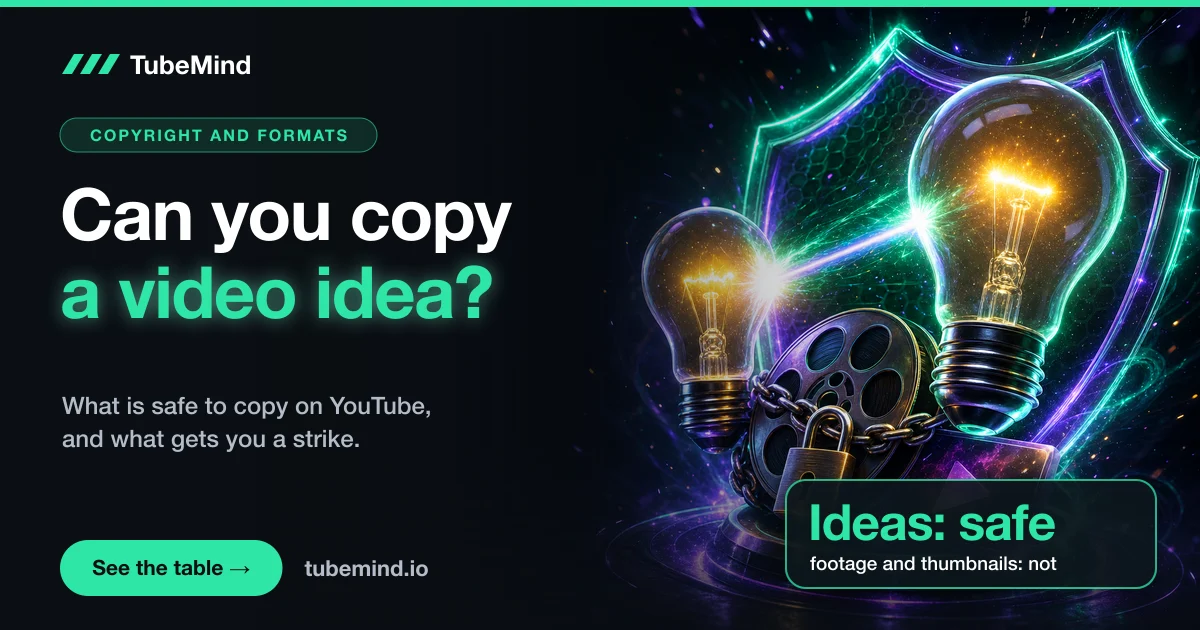
Short answer: Yes, you can copy a YouTube video idea or format. Copyright protects expression, not ideas, so a concept like "I tried X for 30 days" is free to use. What you cannot copy is someone's footage, script, exact thumbnail, music or branding. This is general information, not legal advice; for a specific dispute, talk to a lawyer where you live.
Key takeaways
- YouTube Help says "ideas, facts, and processes aren't subject to copyright". The US Copyright Office says the same about ideas, concepts, systems and methods.
- The US Copyright Office also says copyright does not protect names, titles, slogans or short phrases, though some can be trademarks.
- Footage, scripts, thumbnails and music are creative expression and are protected. 3 copyright strikes in 90 days can end a channel.
- Even legal copying can fail YouTube's monetization review. The reused content policy applies "even if you have permission from the original creator".
- Formats are hard to own. In 2016 the Fine Brothers dropped their plan to license "react" videos after a large backlash.
Everything TubeMind does starts from one idea: find a video format that beat its channel's usual views, then make your own version. So the question I get most after "how do I find outliers?" is "am I allowed to copy them?" I have been on YouTube since 2018, and the short answer is yes, as long as you copy the right part.
On 7 November 2026 I went through YouTube's copyright, fair use, monetization and impersonation pages, the US Copyright Office's guidance, and two court cases about TV formats. Here is where the line sits, in plain words.
Ideas are free, expression is protected
Copyright protects the way something is expressed. The idea behind it stays free. YouTube's copyright page says "intangible things like ideas, facts, and processes aren't subject to copyright", and that a work must be creative and fixed in a physical medium to be protected.
The US Copyright Office puts it this way: "Copyright does not protect ideas, concepts, systems, or methods of doing something." US law says the same in 17 U.S.C. section 102(b).
Here is what that means for a video. Say a creator makes "I cooked every recipe from a 1950s cookbook". The idea, cooking from an old cookbook, is free. Their footage, their narration, their editing and their thumbnail are theirs. If you buy your own old cookbook, film yourself cooking and write your own script, you have made your own video with the same idea.
What is safe to copy and what is not
| What you want to reuse | Safe? | Why |
|---|---|---|
| Format or concept ("24 hours in X") | Safe | An idea or method is not protected |
| Topic | Safe | Ideas and facts are not protected |
| Structure, pacing, hook pattern | Generally safe | A method; the expression you make is your own |
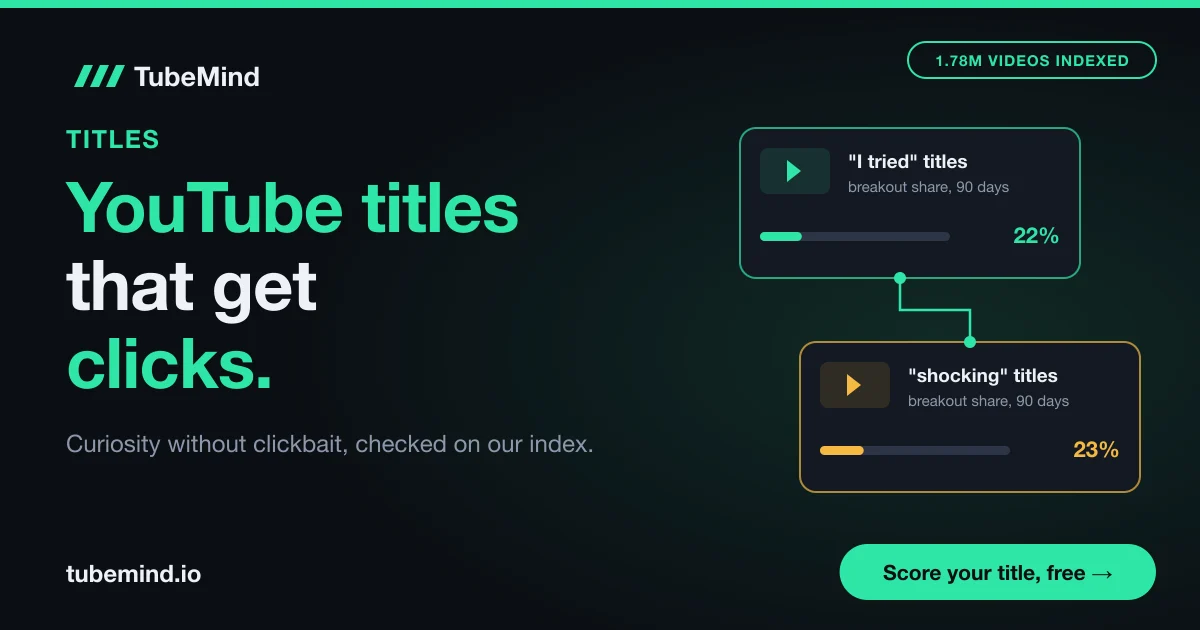
| Title pattern ("I tried X for 30 days") | Generally safe | Titles and short phrases are not protected by copyright; watch for trademarked series names |
| Thumbnail layout idea (face on the left, big text on the right) | Generally safe, gray area if near identical | A layout is an idea; a close copy of the image is not |
| The exact thumbnail image | Not safe | A creative image is protected |
| Footage or clips | Not safe without permission or fair use | Audiovisual work; copyright claims and strikes |
| Script, word for word | Not safe | Written expression is protected |
| Music or original audio | Not safe without a license | Protected work; Content ID claims |
| Channel name, logo, banner, colour scheme | Not safe | YouTube's impersonation policy and trademark law |
The pattern is simple. The further you move from "what the video is about" toward "the exact files and words", the less you can copy. A good rule: if you deleted every frame of their video from the internet, could you still make yours? If yes, you are borrowing an idea. If no, you are copying their work.
YouTube's rules go further than the law
Staying inside copyright law is not the whole story on YouTube. Three platform rules matter.
Copyright strikes
If you use someone's footage, music or images without permission, they can file a removal request, which gives you a strike. YouTube says channels that get "3 copyright strikes in 90 days are subject to termination". Strikes expire after 90 days if you complete Copyright School, as long as you have fewer than 3.
Claims and strikes are not the same thing, and the fix for each is different. My guide on YouTube copyright claim vs strike walks through both.
Fair use can allow some uses, like commentary or criticism, but YouTube warns there are no magic words: "There aren't any magic words to automatically apply fair use." Giving credit does not, by itself, make a copy fair use.
Reused and inauthentic content
Even if a use is legal, it may not be monetizable. YouTube's Partner Program does not pay channels that repurpose content already on YouTube without meaningful changes, and it says that rule applies "even if you have permission from the original creator." Since July 2025 it also calls out "inauthentic" content made from generic templates that gives the impression of mass production. A channel that clones another channel's videos at scale, even with new footage, can fail this review. My guide to the yellow icon and reused content explains the review.
Impersonation
YouTube's impersonation policy bans channels that mislead viewers by copying another creator's identity, including profile pictures, banners or specific colour schemes, and channel names or handles that look or sound like an established one. Copy the format and leave the brand alone.
Can you make Shorts from other YouTubers' videos?
Only in limited ways, and since October 2026 the risk is higher. There are three routes, and they carry very different risk.
| How you use their video | Copyright | Reach and monetization |
|---|---|---|
| YouTube's Remix button (Green Screen, Cut, Collab, Sound) | Allowed by YouTube's tools, if the owner left remixing on | Fine when you add your own reaction, voice or performance |
| Short clip plus your own commentary, teaching or story | Depends on fair use; get permission if unsure | Can be eligible when your part is the main content |
| Re-uploading a clip with captions, music or a voice-over that only describes it | Copyright claims and strikes | Reduced reach and not eligible for monetization |
The first route is built into YouTube. Its Help page on remixed Shorts lists Green Screen, Cut and Collab under the Remix option on a video. Creators control this in Studio with a "Shorts remixing" setting, and some videos cannot be remixed at all, such as private videos or ones claimed by rights holders that have not made them available for Shorts.
The third route is what YouTube targeted on 1 October 2026. In a TeamYouTube post titled "Prioritizing original content on Shorts", YouTube said it would "reduce the reach of content re-uploaded from other creators without adding anything of your own", and that channels mainly aggregating other creators' videos "will likely see less distribution". Reporting on YouTube Creator Liaison Rene Ritchie's video the same day said a voice-over that only describes the clip, small technical edits and template changes do not make a clip original. If your Shorts views fell in October, my guide on why YouTube views drop covers how to check for this.
Two things this does not change. Cutting Shorts from your own long videos is your own content. And monetization still runs on the reused content policy, which applies even when the original creator gave you permission. My view: if you like a clip, react to it with Remix or make your own version of the idea, and leave the re-upload alone.
Names, series titles and trademarks
Copyright does not protect titles or short phrases, but trademark law can protect names that identify a business. The USPTO says a trademark can be "any word, phrase, symbol, design, or a combination" that identifies the source of goods or services. Some creators register their channel or show names. If a series name is a registered trademark, do not use it for your own series, even if the format is free.
Real cases: why formats are hard to own
The Fine Brothers and "React" (2016). The creators behind the popular React series announced React World, a program to license their react formats, backed by trademark filings. The backlash was huge. Within days they cancelled the program, gave up the trademarks and said they would drop related Content ID claims, Tubefilter reported on 2 February 2016. The lesson: a genre like reaction videos is not something one channel can own.
Green v Broadcasting Corporation of New Zealand (1989). The creator of the talent show "Opportunity Knocks" claimed copyright in the show's format, including catchphrases and a "clap-o-meter". The Privy Council refused, because the format was not certain enough to be a protected work.
Banner Universal Motion Pictures v Endemol Shine (2017). The UK High Court accepted that a TV format can in principle be protected, but the claim failed because the claimant's format document was too vague and the two shows were different in every material respect.
I found no court ruling about two YouTubers fighting over a copied video format. Disputes between creators usually play out in public and on the platform, not in court.
How to borrow a format the right way
- Find formats that are working. Look for videos that beat their own channel's usual views, especially on small channels. The free outlier finder lists them for any keyword, and my guide to using outlier videos shows the full method.
- Write down the pattern, not the content. What is the promise, the structure and the payoff? That is the part you can reuse.
- Change at least one big element. A new audience, language, location, angle or format length. The best copies are adaptations.
- Make every file yourself. Your footage, your script, your voice, your thumbnail, licensed music.
- Run the reused content test. Would a viewer see a meaningful difference between your video and the original? If not, keep changing it.
A format that broke out in English often has no good version yet in Urdu, Hindi or Arabic. That kind of adaptation is fair, original, and often the fastest way for a small channel to grow. My guide to writing YouTube titles covers how to keep a winning title pattern without copying the title word for word.
Limits of this guide
- This is general information, not legal advice. Copyright and trademark law differ by country.
- The examples above follow US law and YouTube's global policies. Courts elsewhere may treat close copies differently.
- Fair use depends on the facts of each case. If you plan to use other people's footage, get permission or advice first.
Sources
YouTube Help: copyright on YouTube, copyright strike basics, fair use on YouTube, channel monetization policies, impersonation policy and Copyright Match Tool. US Copyright Office: what does copyright protect and Circular 33. 17 U.S.C. section 102. USPTO: what is a trademark. Cases: Tubefilter on the Fine Brothers, 2 February 2016; Green v Broadcasting Corporation of New Zealand, Privy Council, 1989; Banner v Endemol Shine [2017] EWHC 2600 (Ch). Shorts: create Shorts with remixed content (YouTube Help), the TeamYouTube community post "Prioritizing original content on Shorts" (1 October 2026) and PPC Land and Search Engine Journal coverage of it. All read on 7 November 2026. The cookbook example is made up.
Find formats worth adapting: open the free outlier finder.
Research right on YouTube: the free TubeMind Chrome extension shows the outlier multiplier, a revenue estimate and similar channels on YouTube pages.
Frequently asked questions
Can I make YouTube Shorts using other YouTubers' videos?
Use YouTube's Remix tools (Green Screen, Cut, Collab) where the owner allows them, or add substantial commentary, teaching or storytelling of your own. Since 1 October 2026 YouTube reduces reach for Shorts re-uploaded from other creators without anything added, and those Shorts also fail the reused content rule for monetization.
Is it illegal to copy a YouTube video idea?
No. Copyright protects expression, and YouTube Help says ideas, facts and processes are not subject to copyright. Copying someone's footage, script, thumbnail or music is a different matter. This is general information, not legal advice.
Can I use the same title as another YouTube video?
The US Copyright Office says copyright does not protect names, titles, slogans or short phrases. A registered trademark, such as a series name, is different, and copying a title word for word rarely helps you stand out anyway.
Can I copy someone's thumbnail style?
A general layout, like a face on one side and big text on the other, is an idea. Copying the exact image, or making a near copy, uses their creative work and can lead to a claim.
Does giving credit make it fair use?
No. YouTube says there are no magic words that make a use fair, and credit alone does not turn a copy into fair use. Fair use depends on how much you transform the original and why.
Can copying a format hurt monetization?
Yes, if your videos are close copies. YouTube's reused content policy blocks monetization for channels that repurpose others' content without meaningful changes, even with permission, and mass produced template videos count as inauthentic content.