In this guide
Key takeaways
- TubeMind checked 911,485 videos from 19,479 channels, uploaded between 9 July and 23 October 2026, and grouped them by subscriber count.
- The median long video gets 47% of the channel's subscriber count below 1,000 subscribers, 28% at 1,000 to 5,000, and only 2.5% at 1 million plus.
- On channels under 1,000 subscribers, the median Short gets 518 views, which is more views than the channel has subscribers.
- About 29% of long videos on 1,000 to 5,000 subscriber channels beat the channel's own subscriber count.
- Most views do not come from subscribers. YouTube notifications are personalized by default, and not every upload sends one (YouTube Help).
"I have 1,000 subscribers, so why did my video get 200 views?" is one of the questions I hear most from small creators. The worry makes sense. You did the work, people clicked subscribe, and then most of them did not show up.
On 6 November 2026 I ran a query on TubeMind's index to put real numbers on it. I have been on YouTube since 2018, and I still did not expect one result: on channels under 1,000 subscribers, the typical Short gets more views than the channel has subscribers, while the typical long video reaches less than half of them. Subscriber count tells you less about your next video than most people think. Below are the numbers for every channel size, what they mean for you, and how to check your own channel against them with the free YouTube channel audit.
Normal views per video at every subscriber count
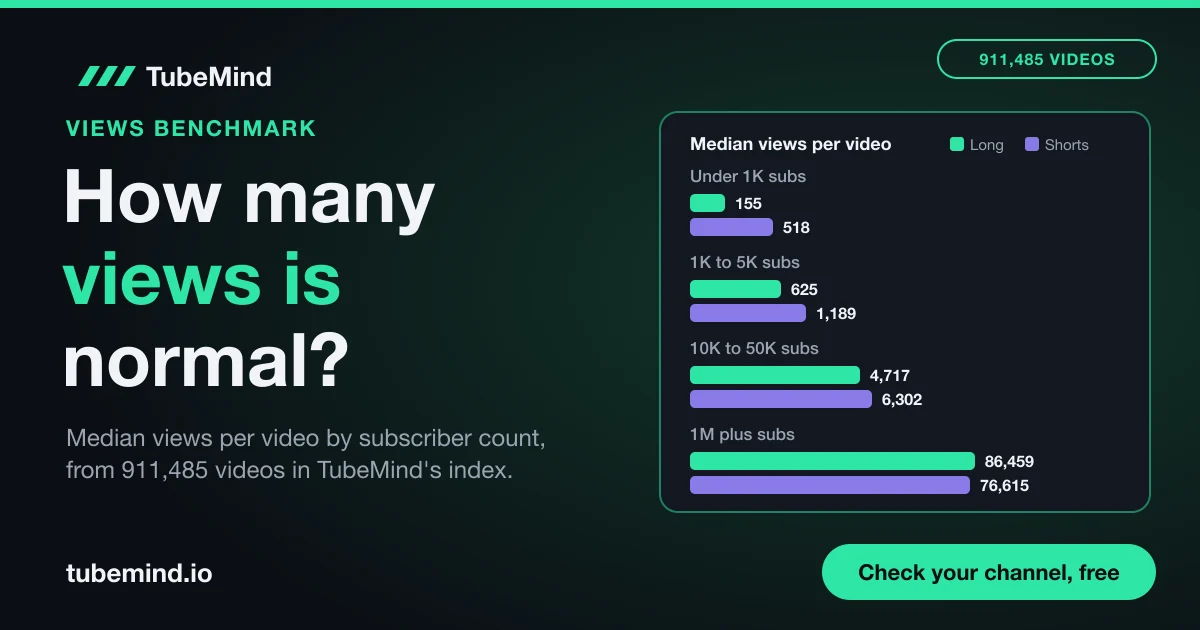
Normal views grow with channel size, but much more slowly than subscribers do. A channel with 100 times more subscribers does not get 100 times more views per video.
The table shows the median, which is the middle video when all videos in a group are lined up from fewest to most views. I use the median because one viral video can drag an average far away from what most uploads get. The "middle half" column shows where 50% of videos land, so anything inside it is ordinary for that channel size.
| Subscribers | Long video median | Long video middle half | Shorts median | Shorts middle half |
|---|---|---|---|---|
| Under 1,000 | 155 | 38 to 610 | 518 | 75 to 1,340 |
| 1,000 to 5,000 | 625 | 145 to 3,196 | 1,189 | 219 to 3,313 |
| 5,000 to 10,000 | 2,068 | 477 to 8,068 | 2,213 | 588 to 13,285 |
| 10,000 to 50,000 | 4,717 | 1,070 to 16,956 | 6,302 | 1,367 to 33,492 |
| 50,000 to 100,000 | 9,049 | 2,571 to 32,660 | 17,135 | 3,102 to 65,484 |
| 100,000 to 500,000 | 17,549 | 4,776 to 60,402 | 28,253 | 5,670 to 129,115 |
| 500,000 to 1 million | 33,238 | 8,793 to 118,416 | 37,426 | 8,222 to 202,131 |
| 1 million plus | 86,459 | 20,098 to 345,815 | 76,615 | 17,454 to 476,644 |
Look at how wide the middle half is. On a 1,000 to 5,000 subscriber channel, a long video with 150 views and one with 3,000 views are both normal. That is a 20 times gap inside the "ordinary" range, which is why comparing one video with another creator's screenshot tells you very little.
The ranges are also uneven. The median sits much closer to the low end than the high end in every group. Most videos get modest views, and a smaller number of videos pull far ahead. That pattern is how YouTube works at every size, and it is the reason tools like the outlier calculator compare a video with its own channel's usual views instead of with a fixed number.
What 1,000 subscribers means for your views
With 1,000 subscribers, a long video that gets around 150 to 600 views in its first months is normal. Getting 28% of your subscriber count is the median for channels from 1,000 to 5,000 subscribers.
Here is the math with a worked example. Say your channel has 1,200 subscribers. The median ratio for your group is 27.8%, so a typical long video would land near 1,200 x 0.278 = about 330 views. If your last five long videos got 120, 260, 340, 410 and 900 views, you are right in the normal range. One of them even beat the median by a wide margin.
About 29% of long videos on these channels get more views than the channel has subscribers. So beating your subscriber count is possible but not the usual result. If one in three or four of your videos does it, you are doing as well as most channels your size.
Shorts look different. On 1,000 to 5,000 subscriber channels, the median Short gets 1,189 views, about 52% of the subscriber count, and 34% of Shorts beat the subscriber count. A Short can reach people who have never heard of you, because the Shorts feed shows videos to viewers based on what they swipe through rather than who they follow.
If you are still working toward 1,000 subscribers, the bar is lower: a median of 155 views per long video, with the middle half between 38 and 610. My guide on getting your first 1,000 subscribers has a 90 day plan for that stage.
Why most of your subscribers do not watch each video
Subscribers do not see every upload. YouTube decides who gets a notification and what shows up on each person's home page, so a subscriber is a possible viewer, not a guaranteed one.
Three facts from YouTube's own Help Center explain most of the gap:
- When someone subscribes, the bell is set to personalized notifications by default, and YouTube says not every new upload will send a notification. Viewers also get at most 3 upload and live notifications from one channel in 24 hours (YouTube Help: manage notifications).
- Subscribers still have to choose your video over everything else on their home page. If your title and thumbnail do not fit what they want that day, they skip it.
- YouTube Studio has a report called watch time from subscribers, which shows what share of your watch time comes from subscribers versus people who are not subscribed (YouTube Help: understand your audience). On most growing channels, viewers who are not subscribed bring in most of the views.
There is also a quieter reason. People subscribe for one video and their interests move on. A subscriber from a gaming clip two years ago may not care about your new tutorials. Your subscriber count never goes down for that, but the number of people who still want your videos does.
Views to subscribers ratio: what counts as good
The views to subscribers ratio is a video's views divided by the channel's subscriber count, written as a percent. A good ratio depends on your size: 25% or more is solid under 10,000 subscribers, while 5% is normal above 500,000.
The chart shows the ratio falling as channels grow. A 1 million subscriber channel gets a median of 2.5% per long video, while a channel under 1,000 subscribers gets 47%. Big channels collected subscribers over many years, and many of those people stopped watching long ago. Small channels have fresh subscribers who joined last month.
| Subscribers | Long: median ratio | Long: share beating sub count | Shorts: median ratio | Shorts: share beating sub count |
|---|---|---|---|---|
| Under 1,000 | 47.1% | 35.8% | 153.7% | 57.8% |
| 1,000 to 5,000 | 27.8% | 28.8% | 51.8% | 33.9% |
| 5,000 to 10,000 | 29.1% | 27.2% | 30.7% | 31.9% |
| 10,000 to 50,000 | 20.0% | 20.7% | 27.0% | 30.9% |
| 50,000 to 100,000 | 12.8% | 14.7% | 24.0% | 24.1% |
| 100,000 to 500,000 | 7.8% | 8.0% | 13.2% | 19.6% |
| 500,000 to 1 million | 4.7% | 3.5% | 5.4% | 12.4% |
| 1 million plus | 2.5% | 1.6% | 2.1% | 7.0% |
So a fixed rule like "10% is good" is wrong for small channels and too strict for big ones. A 1,000 subscriber channel at 10% (100 views per video) is below the median for its size. A 2 million subscriber channel at 10% (200,000 views) is doing far better than most channels of that size.
You can work out your own ratio in a few seconds with the YouTube video stats checker: paste a video link, take its views, and divide by the channel's subscribers. For likes and comments as well as views, use the engagement rate calculator.
Shorts vs long videos: why Shorts numbers look bigger
Shorts get higher view counts than long videos on small channels, partly because of how YouTube counts them. Since 31 March 2025, a Shorts view counts each time a Short starts to play or replays, with no minimum watch time (YouTube Help: Shorts).
YouTube still shows the older number, called engaged views, in YouTube Studio's advanced mode, and that is the number used for Partner Program eligibility and Shorts pay. Engaged views are always equal to or lower than views, and on Shorts that people swipe past quickly the gap can be large. So when you compare a Short with a long video, remember that a long video view means someone chose to watch, while a Short view can be a quick swipe past.
The Shorts lead also shrinks as channels grow. At 1 million plus subscribers, the median Short (76,615 views) gets fewer views than the median long video (86,459). Big channels have audiences who come back for long videos, while small channels depend more on the Shorts feed to reach anyone at all.
My view: if you are under 5,000 subscribers, do not judge your channel by Shorts views alone. They are good for reach, but a long video with 400 views and strong watch time often brings more loyal subscribers than a Short with 2,000 swipes.
How to check your channel against these numbers
Compare your recent videos with the right row of the table, using the median, and give each video at least two weeks before you judge it.
- Open YouTube Studio, go to Analytics, then Advanced mode, and pick the last 120 days.
- Remove videos younger than 14 days. They are still collecting views, and our data left them out for the same reason.
- Split long videos and Shorts, then sort each list by views and pick the middle video. That is your median.
- Find your row in the table above and see where your median lands in the middle half range.
- For a quicker check, run the free channel audit, which compares your views per video and uploads a month with channels of your size.
Then use this decision table:
| Your median vs the table | What it usually means | What to do |
|---|---|---|
| Above the middle half | Your topic and packaging work better than most channels your size | Make more of the same format and study which videos led the way |
| Inside the middle half | You are normal for your size | Work on titles, thumbnails and the first 30 seconds to move toward the top of the range |
| Below the middle half | Viewers are not clicking or not staying, or the topic has little demand | Read why your channel is not growing and check the topic first |
| Was normal, then fell | A change in topic, upload gap, or a past hit fading | Follow the steps in why YouTube views drop |
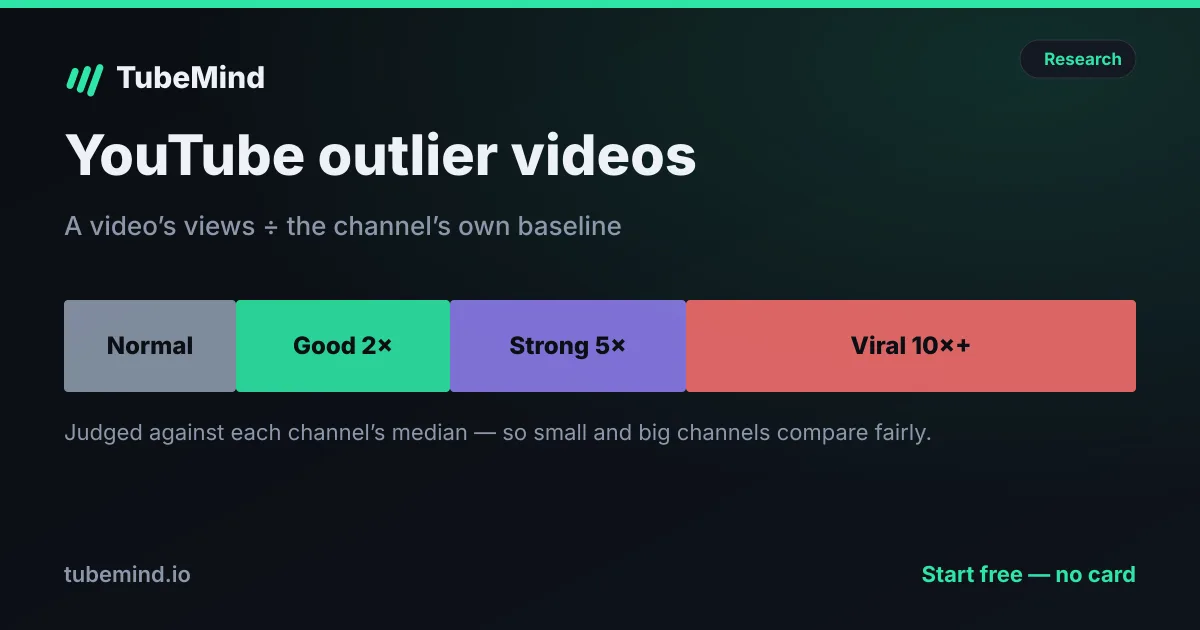
One more check is worth doing. Look at your best video of the last 120 days and divide its views by your median. If it is 3 times your median or more, that video is an outlier for your channel, and its topic is your strongest lead. My guide on outlier videos shows how to find the same pattern on other channels in your niche.
Where these numbers can mislead you
These benchmarks come from a large sample, but they are not a rule YouTube sets, and they fit some channels better than others.
- Niche matters. A channel about local news in Urdu and a channel about US personal finance live in very different markets. Use the table to see if you are in a normal range, then compare with channels in your own topic.
- Our index is not a random sample of YouTube. TubeMind tracks channels found through niche research, comments and user searches, so very inactive channels are underrepresented. Small channels in our data may do a little better than an average small channel.
- Subscriber counts are from today. We compared each video's views with the channel's subscriber count when our crawler last checked, not on the day of upload. YouTube also rounds public subscriber counts (YouTube Data API: channels).
- Views keep growing. A video uploaded in July has had more time than one uploaded in October. Evergreen videos can keep climbing for years, so a slow start does not always mean a failed video.
The most useful comparison is still your channel against itself. If your median is rising over three or four months, you are moving the right way, whatever the table says.
Sources and method
Data: TubeMind index, queried read only on 6 November 2026. 911,485 videos from 19,479 channels, uploaded between 9 July and 23 October 2026 (14 to 120 days before the query), grouped by the channel's subscriber count. Channels with hidden subscriber counts were left out. Views are the count at our crawler's last check of each video. The ratio is each video's views divided by its channel's subscribers; the tables show medians and the 25th to 75th percentile range. All channel and video data comes from the official YouTube Data API; the method is in how our scores work. YouTube facts: manage notifications, understand your audience, YouTube Shorts and YouTube Data API channels resource, all checked 6 November 2026. The 1,200 subscriber example is hypothetical.
Want to know if your views are normal for your size? Run a free channel audit and compare with channels like yours.
Research right on YouTube: the free TubeMind Chrome extension shows the outlier multiplier, a revenue estimate and similar channels on YouTube pages.
Frequently asked questions
What percentage of subscribers watch your videos?
Far fewer than most creators expect. In TubeMind's data from 6 November 2026, a typical long video on a 1,000 to 5,000 subscriber channel got views equal to 28% of the subscriber count, and that number includes viewers who are not subscribed. The share of views coming from subscribers alone is smaller. YouTube Studio's audience tab shows your own split.
Is 100 views good for a small YouTube channel?
Under 1,000 subscribers, yes. The median long video on those channels got 155 views, and the middle half ranged from 38 to 610. At 1,000 to 5,000 subscribers, 100 views sits in the bottom quarter, so look at your titles, thumbnails and topic. Give each video at least two weeks before judging it.
Why do my Shorts get more views than my long videos?
The Shorts feed shows videos to people who do not follow you, and since 31 March 2025 YouTube counts a Shorts view every time a Short starts or replays. On channels under 1,000 subscribers, the median Short got 518 views against 155 for a long video. Compare engaged views in YouTube Studio for a fairer picture.
Does a low views to subscribers ratio hurt my channel?
YouTube has not published any rule that punishes a channel for a low ratio. Recommendations follow how viewers respond to each video, such as clicks and watch time. A falling ratio is still a useful warning that your current videos fit your audience less well than older ones did, so treat it as a signal to check your recent videos.
Do I need more subscribers to get more views?
Not directly. Subscribers help a new video get its first viewers, but most views on growing channels come from people who are not subscribed. In our data, 29% of long videos on 1,000 to 5,000 subscriber channels beat their subscriber count. A strong topic and clear packaging can outgrow a small subscriber base.