In this guide
Key takeaways
- There is no official average time to 4,000 watch hours. YouTube publishes the bar, not how long channels take to clear it.
- A channel can only reach 4,000 hours if it earns at least 334 public hours a month, because hours older than 12 months drop out.
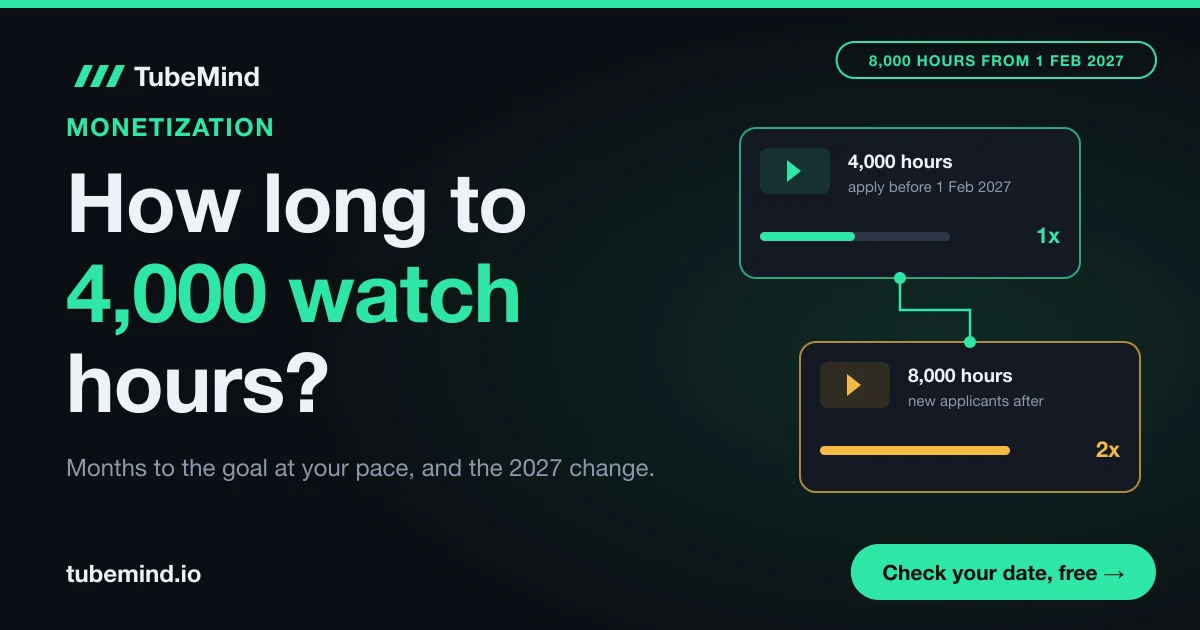
- From 1 February 2027, YouTube asks new applicants for 8,000 qualified watch hours in the last 365 days. That needs a channel about twice as big, so waiting longer does not get you there.
- In TubeMind's niche data (3 November 2026), the median long-form video is 32 minutes in History Documentary but 15 minutes in Urdu Facts, which caps how fast each niche can collect hours.
- After you cross the bar, YouTube's review takes about a month, and AdSense pays between the 21st and 26th of the month once your balance reaches the payment threshold.
"How long until I get 4,000 hours?" is the question I get most from new creators, in comments, in DMs and at events. Most of them want a number of months. The trouble is that two channels starting on the same day can be months apart, and the gap has little to do with how hard each person works. You can get your own date from the watch time calculator; this guide explains what sits behind that date.
This guide gives you realistic timelines for different kinds of channels, explains why the first months feel so slow, and shows what the jump to 8,000 hours in February 2027 does to your plan. Once you see what drives the date, you can move it earlier.
The short answer: it depends on two numbers, and time is the third
Your timeline comes from your long-form views per month and your average view duration. Time is the result of those two numbers. It is never the input.
Here is the simple math. Multiply your monthly long-form views by your average view duration in minutes, then divide by 60. That gives you the public watch hours you add each month. Divide 4,000 by that number and you have the months you need, for a channel whose hours are not yet expiring.
One rule sits on top of this math. YouTube counts only the last 12 months of watch time, according to the YouTube Partner Program overview (checked 3 November 2026). So a channel that adds 300 hours every month never reaches 4,000. After a year it holds 3,600 hours, and from then on each new month only replaces the month that drops out.
That gives every channel a ceiling: 12 times its monthly hours. If your ceiling is below 4,000, more months will not help. Only more views or longer watching will.
Realistic timelines for different channels
Most channels reach 4,000 hours somewhere between a few months and never. The table below shows where you land, depending on your monthly long-form views and your average view duration, for a channel that keeps a steady pace from zero.
| Long-form views a month | 3-minute average | 5-minute average | 8-minute average |
|---|---|---|---|
| 2,000 | Never (stops at 1,200 hours) | Never (stops at 2,000) | Never (stops at 3,200) |
| 5,000 | Never (stops at 3,000) | 10 months | 6 months |
| 10,000 | 8 months | 5 months | 3 months |
| 20,000 | 4 months | 3 months | 2 months |
| 50,000 | 2 months | Under 1 month | About 18 days |
TubeMind calculation, months rounded up. Assumes the same views and average view duration every month and only public long-form videos. Figures are illustrations only.
How to read it: find the row closest to your monthly long-form views, then the column closest to your average view duration. The cell is your time to 4,000 hours if nothing changes. "Never" means your 12-month ceiling is under 4,000, and the number in brackets is where your total stops growing.
Take the 5,000 views row. At a 3-minute average, that channel collects 250 hours a month and tops out at 3,000 hours. Move the same channel to a 5-minute average and it gets there in 10 months. Nothing changed except how long people stayed on each video. This is why I tell new creators to fix retention before they chase more uploads.
Look at the 2,000 views row too. Many small channels sit here for their whole first year. At that level the channel cannot reach 4,000 hours at any normal average view duration, so the plan has to be about getting more views per video, through better topics and packaging.
Why the first months feel so slow
New channels almost never grow at a steady pace. They start near zero and speed up, so most of the hours arrive in the second half of the first year. That is why so many people quit in month four, just before things improve.
Here is a hypothetical example. Say your channel starts with 300 long-form views in month one and grows a little every month, reaching 14,000 views in month twelve, with a 5-minute average view duration all the way.
| Period | Long-form views | Hours added | Total public hours |
|---|---|---|---|
| Months 1 to 3 | 1,900 | 158 | 158 |
| Months 4 to 6 | 7,500 | 625 | 783 |
| Months 7 to 9 | 19,500 | 1,625 | 2,408 |
| Months 10 to 12 | 36,000 | 3,000 | 5,408 |
Hypothetical channel, TubeMind calculation. Monthly views: 300, 600, 1,000, 1,500, 2,500, 3,500, 5,000, 6,500, 8,000, 10,000, 12,000, 14,000. Hours = views × 5 minutes ÷ 60.
What the table shows: after six months, this channel has only 783 hours, about a fifth of the goal. A creator looking at that number in month six would think 4,000 is three years away. Yet the same channel crosses 4,000 hours during month eleven, because months ten to twelve alone bring 3,000 hours.
Growth on YouTube compounds. Each video you post keeps getting views from search and suggested for months, so video number 40 sits on top of the views still coming in from videos 1 to 39. A slow first half does not mean a slow year.
The opposite also happens, and you should know about it. If your channel had one big video last year and nothing since, its hours leave your total one month at a time, and your Studio number goes down while you upload. The calculator page explains this rolling 12-month window in detail, with a box for the hours you are about to lose.
What decides your speed (and what does not)
Four things move your timeline: video length, the views each video gets, your topic, and how much of your work goes into long-form videos. Upload count on its own matters less than most people think.
Video length sets the ceiling for watch time
Average view duration can never be longer than the video. A 6-minute video with strong retention might hold people for 3 minutes. A 25-minute video with weaker retention can still hold them for 8. Longer videos are not automatically better, but in topics where viewers want depth, a short video leaves hours on the table.
Views per video beat number of videos
Say you post 50 videos in a year and each gets 1,000 views at a 5-minute average. That is about 4,167 hours, just enough. Now say you post 25 videos and each gets 3,000 views at the same average. That is 6,250 hours, with half the work. The second creator spent more time on topics and thumbnails, and fewer hours editing.
Your niche
Some topics hold attention for 20 minutes or more, like history, true crime and explainers. Others are built for quick answers, like tech fixes. Both can work, but in a quick-answer niche you need far more views for the same hours. If you have not picked a topic yet, my guide on how to find a YouTube niche walks through the checks.
Shorts do not move this number
Watch hours from Shorts in the Shorts feed do not count toward the 4,000, according to YouTube's eligibility page. Shorts can bring subscribers and send some people to your long videos, which helps. But a channel that posts 90% Shorts is building toward a different goal, the Shorts views route, which is a separate race with its own numbers. Our post on what YouTube pays for Shorts covers that side.
What our niche data shows about video length and breakouts
TubeMind tracks long-form length, Shorts share and breakout channels for every niche in its index of 1.8M+ videos. I pulled three niches on 3 November 2026 to show how different the starting point can be. Each row uses the most recent 3,000 videos we hold for that niche, published between September and early November 2026.
| Niche | Median long-form length | Shorts in recent uploads | Channels under 10K subs | Young winners (30 days) |
|---|---|---|---|---|
| History Documentary | 32 minutes | 1,823 of 3,000 (61%) | 126 of 395 | 24 |
| Psychology Facts | 20 minutes | 2,665 of 3,000 (89%) | 176 of 357 | 40 |
| Urdu Facts | 15 minutes | 1,910 of 3,000 (64%) | 76 of 216 | 16 |
Source: TubeMind niche data, 3 November 2026. Young winners are channels under 10,000 subscribers with a video at 5 times or more of their median views in the last 30 days. Method: how our scores work.
What these numbers mean for you, one column at a time.
Length. The typical History Documentary upload is twice as long as the typical Urdu Facts upload. If both hold viewers for a third of the video, the history channel gets about 10 minutes per view and the Urdu channel about 5. The history channel then needs about half the views for the same 4,000 hours. This is not a reason to avoid Urdu content. It is a reason to plan for more views per video if you work in a shorter format.
Shorts share. In Psychology Facts, 89% of recent uploads in our sample are Shorts. A new channel that copies what it sees in that niche could spend months posting videos that add nothing to its watch hours. If you want the 4,000-hour route, make sure most of your effort goes into long-form.
Young winners. Psychology Facts had 40 channels under 10,000 subscribers with a breakout video in the last 30 days. One breakout of that kind can bring more hours in a week than a small channel earns in a quarter. It is the single fastest route to 4,000 hours, and you can study those videos with the outlier finder or check a topic first with the niche checker.
The 2027 change: why 8,000 hours is more than double the wait
From 1 February 2027, new creators applying for the YouTube Partner Program need 8,000 qualified watch hours in the last 365 days, or 20 million qualified Shorts views in the last 90 days, plus 1,000 subscribers. YouTube announced this on the YouTube Official Blog on 10 August 2026, and the Changes to YPP help page confirms it. Creators already in the program are not affected.
Most people read this as "the same climb, twice as long". The 12-month window makes it harder than that.
To hold 8,000 hours inside any 365 days, your channel must add about 22 public hours a day on average, or about 667 hours a month. A channel that adds 400 hours a month reaches 4,000 in 10 months. That same channel can never reach 8,000, because its ceiling is 4,800. It does not need more time. It needs to become a bigger channel.
Go back to the first timeline table and run it for 8,000 hours, and the picture changes:
| Channel | Time to 4,000 hours | Time to 8,000 hours |
|---|---|---|
| 5,000 views a month, 8-minute average | 6 months | 12 months (only just) |
| 10,000 views a month, 3-minute average | 8 months | Never (stops at 6,000) |
| 10,000 views a month, 5-minute average | 5 months | 10 months |
| 20,000 views a month, 5-minute average | 3 months | 5 months |
| 50,000 views a month, 3-minute average | 2 months | 4 months |
TubeMind calculation, months rounded up, steady pace from zero, public long-form only.
How to read it: the second row is the important one. That channel reaches 4,000 hours in 8 months, which feels fine today. After 1 February 2027 it would sit at 6,000 hours forever unless its views or watch time grow. For big channels the change costs a few months. For small and mid-size channels it can change the whole plan.
Two things do not change. Your hours do not reset on 1 February 2027: whatever you have earned in the last 12 months still counts, now toward 8,000. And the 1,000 subscribers rule stays the same.
One open question matters a lot if you are close. Neither the YouTube blog post nor the help page says how YouTube treats an application that is submitted before 1 February 2027 but still under review on that date. Reviews take about a month, so if you plan to use the 4,000-hour bar, do not leave your application for late January.
Race for 4,000 or plan for 8,000? A decision guide
Your choice depends on how far you are from the bar and how fast you are moving. Here is how I would decide, from today.
| Where you are now | What I would do |
|---|---|
| Over 4,000 hours and 1,000 subscribers | Apply this week from the Earn page. Check AdSense, 2-Step Verification and strikes first. |
| Hours done, subscribers short | Put every video toward subscribers: end screens, a clear reason to subscribe, community posts. |
| Close on both, and your current pace closes the gap by mid-December | Push: one or two strong long videos on your best topic, a public live stream saved as a video, playlists. |
| Your pace would need to double or more to make it | Plan for 8,000. Use the time to raise average view duration, which helps both goals. |
| Under 1,000 hours with no breakout yet | Plan for 8,000 and focus on finding one topic that works before you scale. |
In plain words: the deadline is only worth chasing if your current numbers can get you there with a push, not a miracle. To see your daily pace against the deadline, enter your Studio numbers in the YouTube watch time calculator. If you are not sure where your channel stands on all the YPP checks, the monetization requirements checker compares public numbers against each rule.
One warning about rushing. A last-minute burst of thin uploads or reused clips can hurt you in the review, which looks at your content as well as your numbers. Being rejected costs you time too: YouTube's overview page says you can reapply after 30 days, and after a second rejection the wait is 90 days.
A 90-day plan to grow watch hours
Whichever goal you pick, the next 90 days should focus on raising hours per video. These are the steps I would take, in this order.
- Find your best video. Open Analytics, sort your long-form videos by watch time for the last 90 days, and note the top three. Their topics are your proof of what your audience wants.
- Make three more on those topics. Same audience, a new angle each time. Search the topic in the outlier finder to see which versions beat their channel's normal views.
- Fix the first 30 seconds. Check the retention graph of your last five videos. If a big share leaves in the opening, start with the payoff and cut the warm up.
- Add chapters and a next-video end screen to every upload. Chapters stop people leaving when they want one part. End screens turn one view into two.
- Go live once a week on your topic and keep the stream public. Public streams saved as videos count toward watch hours. Unlisted or deleted ones do not.
- Do not delete or unlist old videos. Their hours leave your total the moment you do.
- Check your pace every month. Put the new numbers into the calculator and see if your date moves earlier.
A full review of what is holding your channel back, from titles to upload rhythm, is what the channel audit is built for.
After 4,000 hours: how long until the first payment
Reaching the bar is not the same as getting paid. From the day you cross 4,000 hours and 1,000 subscribers, expect roughly two to three months before money reaches your bank.
| Step | Typical time | Source |
|---|---|---|
| Apply, accept terms, link AdSense, turn on 2-Step Verification | One day if ready | YouTube Help |
| YouTube review | About 1 month, sometimes longer | YouTube Help |
| Ads start, earnings build for the month | Rest of that month | Your channel |
| Earnings finalized | Around the 3rd of the next month | Google AdSense Help |
| Payment sent, if balance reached the threshold by the 20th | Between the 21st and 26th | Google AdSense Help |
Read the table top to bottom as one path. Say you are approved in mid-March. Your March earnings are finalized in early April, and if your balance has reached the payment threshold by 20 April, the money is sent between 21 and 26 April. If your balance is still below the threshold, it rolls over to the next month. The dates come from Google's AdSense payment timeline.
For creators in Pakistan and India, add time for the address PIN letter and tax information in AdSense, which can hold a first payment. If you passed the numbers and something is still stuck, my guide on why a YouTube channel is not monetized goes through each status. And for what the first months are likely to pay, read how many views you need to get paid.
Where these timelines can mislead you
Every timeline in this post is a model, and models break in a few predictable ways.
- Viral months. If you use your best month as your normal month, your date will be months too early. Use a typical month.
- Subscribers. All the tables above are for hours only. Many channels finish their hours first and wait on subscribers, or the other way round.
- Studio numbers. The Earn page shows public watch hours. Total watch time in Analytics is often higher, because it includes hours that do not count. Plan from the Earn page.
- Decay. Old videos lose views over time. A channel that stops uploading does not hold its pace.
- Policy. YouTube announced a higher bar in August 2026 and can change it again. Check the official pages before you apply.
Sources and method
Policy facts were checked on 3 November 2026 on the YouTube Partner Program overview, Changes to YPP, the YouTube Official Blog post of 10 August 2026 and the AdSense payment timeline. Timeline tables are TubeMind calculations: monthly hours = long-form views × average view duration in minutes ÷ 60, months = 4,000 (or 8,000) ÷ monthly hours, rounded up, with a 12-month cap. They assume a steady pace and are illustrations. Niche figures come from TubeMind's niche data on 3 November 2026, using the most recent 3,000 videos per niche (History Documentary, 395 channels; Psychology Facts, 357; Urdu Facts, 216), built from public data fetched through the official YouTube Data API. TubeMind's index held 1,785,460 videos across 21,452 channels on that day. Method in how our scores work.
Want your own date? Enter your Studio numbers in the watch time calculator, free and private.
Research right on YouTube: the free TubeMind Chrome extension shows the outlier multiplier, a revenue estimate and similar channels on YouTube pages.
Frequently asked questions
Can you get 4,000 watch hours in one month?
Yes, but only with big numbers. 4,000 hours in 30 days is about 133 hours a day, which is about 2,000 long-form views a day at a 4-minute average view duration. Most channels that do it in a month have one video that breaks out, or a large audience from another platform. For a new channel, a one-month timeline is the exception.
Is one year enough to get 4,000 watch hours?
It is enough if your channel averages at least 334 public hours a month over those 12 months, for example 5,000 long-form views a month at a 4-minute average. Many channels start slower and speed up, so they cross the bar late in the first year or in the second. If your 12-month total stops growing, you need more views or longer watching, not more time.
What is the average time to reach 4,000 watch hours?
YouTube does not publish one, and figures like "6 to 12 months" you see online come without a data source. The honest answer is a range: a few weeks for a channel with a breakout video, and never for a channel whose monthly hours times 12 stays under 4,000. Work out your own date from your monthly views and average view duration.
Will my watch hours reset on 1 February 2027?
No. Nothing resets on that date. Hours you earned in the last 12 months still count, but if you apply as a new creator after 1 February 2027, YouTube asks for 8,000 qualified watch hours in the last 365 days instead of 4,000. The 1,000 subscribers rule stays the same, and channels already in the program are not affected.
What if I apply in January 2027 and the review finishes in February?
YouTube has not said. Neither its blog post nor the Changes to YPP help page covers applications that are still under review on 1 February 2027. Reviews take about a month, so if you want the 4,000-hour bar, meet both numbers and apply as early as you can rather than in the last weeks of January.
How long does 8,000 watch hours take compared with 4,000?
Often more than twice as long, and sometimes it is out of reach at your current size. 8,000 hours in 365 days needs about 667 public hours a month on average. A channel adding 500 hours a month reaches 4,000 in 8 months but stops at 6,000, so it must grow its views or watch time to reach 8,000 at all.
How many videos does it take to get 4,000 watch hours?
There is no fixed number. Say each of your videos gets 1,000 views in a year at a 5-minute average: that is about 83 hours a video, so you need about 48 videos. If each gets 3,000 views, about 16 are enough. Better topics and packaging cut the number of videos faster than uploading more often does.
Do longer videos get me to 4,000 hours faster?
Only if people keep watching. Average view duration can never be longer than the video, so longer videos raise your ceiling. A 25-minute video watched for 8 minutes beats a 6-minute video watched for 3. But a long video that people leave early can do worse than a tight short one, so check your retention graph before you stretch your videos.
Can an Urdu or Hindi channel reach 4,000 hours as fast as an English one?
Yes. Watch hours count the same in every language, and RPM does not affect the threshold. The difference is format: in TubeMind's niche data on 3 November 2026, the median long-form video was 15 minutes in Urdu Facts and 32 minutes in History Documentary, so shorter formats need more views for the same hours.
How long after reaching 4,000 hours do I get paid?
Usually two to three months. YouTube's review takes about a month. After approval, earnings for a month are finalized around the 3rd of the next month, and AdSense pays between the 21st and 26th if your balance has reached the payment threshold by the 20th. In Pakistan and India, also allow time for the AdSense PIN and tax details.